With three hundred agricultural commodities grown in Michigan, only California grows a more diverse crop of agricultural products in this country and Michigan’s dairy producers are big players in supplying the local demand of Michigan grown products.

“Our research shows that 63 percent of Michiganders prefer to buy products grown and raised in Michigan but there is an obstacle to finding them,” explains Noelle Nachreiner, Executive Director of the Michigan Agricultural Council (MAC). “This is where the Ag Council can make a difference through our Michigan GROWN, Michigan GREAT campaign. Our goal is to increase the percentage of people who are buying locally grown food while improving the perception of farming practices.”

Nachreiner has been on the job at the Michigan Ag Council since June and has her work cut out for her. “The mission of the Michigan Ag Council is to build awareness among Michigan consumers about today’s food and agriculture.” Nachreiner continued, “MMPA is one of twenty-two commodity groups and businesses who partner with the council to serve as one unified voice to share the story of farmers and build trust in the agriculture sector, resulting in the purchase of more Michigan-based products.”

Representing MMPA on the council, Animal Care Coordinator Lindsay Green serves as board president. As the goal of the MAC is to connect the producers with consumers, Green explains that this affiliation allows MMPA, “another opportunity to tell our producers stories and grow trust of Michigan’s dairy farmers. We contribute to the council monetarily at a level that allows us to have a voting position on the board and to be an influential contributor to the council’s mission.”

The latest campaign of the MAC is Michigan GROWN, Michigan GREAT and this is highlighted on the MAC website at michigangrown.org. With a plethora of ag facts, recipes and products grown in Michigan, this website is comprehensive in showing what’s grown, who grows it and brings a trustworthy face to the Michigan farmer. There are several videos of Michigan farmers explaining what they grow and why they grow it, including MMPA Member Ashley Kennedy of Sheridan Dairy who discusses the importance of family on their Thumb area farm.

“Through Michigan GROWN, Michigan GREAT, consumers have the chance to connect the food they’re consuming to the hands who produced it. In today’s culture, transparency and authenticity is of the utmost importance,” Nachreiner said. “Through our podcast and other opportunities to interact, we tell farmers’ stories and put a face to agriculture, showing that farmers and those who work in agriculture care just as much about the food and products they are producing as those who are consuming it. Our impact is the humanization we provide of the agriculture sector.”

“The ag council creates an additional outlet for our producer stories to be told and with the branding goals we have looking into the near future we hope that the ‘Michigan Grown, Michigan Great’ logo will be recognized by consumers and will encourage them to increase their consumption of dairy and the other commodities,” Green added.

Social media has great influence on consumers, with authorities from all corners of the food sphere touting their beliefs and sometimes spreading food myths. The MAC has been a large part of delivering sound science and practical knowledge about how food is grown.

“Whether it’s through videos, podcasts or photos, our message can be amplified with the right tools. It also provides an opportunity to engage with consumers in a different way,” Nachreiner said. “While having face-to-face conversations is always preferred, social media allows us to answer questions and share stories that consumers may otherwise not hear if they aren’t in places where agriculture is prevalent.”

In 2020 and beyond Nachreiner said, “The Michigan Ag Council’s top priority is to increase our brand recognition among consumers and build trust in Michigan farmers and demand for their products. To this end, we will be taking a grass roots approach to begin conversations in spaces where consumers are and already have a baseline trust in farmers. We will be working with farmers markets throughout the state to bring the Michigan GROWN, Michigan GREAT message to the forefront and share farmer stories with consumers in these venues.”

“The council is an important organization in that it creates a collective voice for Michigan agriculture and the state’s commodities,” Green said. “Creating a trusted brand that benefits Michigan agriculture, as a whole, is a win in my book. I also believe that creating a collective voice shows our consumers that we care, that we want to communicate and create relationships and that their trust is important to us.”

This article was originally published in the November/December 2019 issue of the Milk Messenger. Subscribe »

Dairy products have always taken center stage during the holiday season. From the Christmas cookies prepared with plenty of butter to the warm beverages created with frothy milk, everyone gets their fill of the delicious, nutritious and wholesome products dairy farmers have to offer.

Those involved in the dairy industry know that after producing real milk and real dairy products from real cows, there isn’t room for milk substitutes at the table. After all, margarine is never a replacement for butter in a Christmas cookie recipe and nothing else can produce that perfect latte froth.

A desire for realness can be also be found in the Great Lakes region’s tree industry. A real Christmas tree is what makes the magic of the holiday season come true because nothing can bring back childhood memories like the citrusy, pine smell filling a living room on Christmas morning.

For the Booms family in Moorestown, Michigan, realness during Christmas is enjoyed on a whole different level. While their barn is filled with 100 black and white Holsteins producing the real milk to go along with Santa’s cookies, 10 acres of their field is filled with rows and rows of evergreens producing the real Christmas tree that their gifts are set under.

Real Dairy

Booms Dairy began in 1987 after Russell Booms fell in love with milking cows growing up on his dad’s dairy farm. According to Russell, after you do something that long, it just makes sense to continue the practice while being your own boss on your own farm.

Today, Russell works hand in hand with his son, Jordan, who is gearing up to someday take over their operation. With family being their main motivator to wake up in the morning and milk cows, they’ve enjoyed the flexibility that comes with working as a family.

“We have a set schedule that just works for us,” Jordan explained. “Basically, we milk every other and one day a week one of us doesn’t milk at all so that a guy has a day off completely.”

This schedule has also allowed Jordan to give back to his community by serving as a volunteer firefighter at two local departments. The heroic effort was never his plan as a kid, but during high school, he realized the benefit that he could provide to members of his community in the role.

“I thought that becoming a firefighter was something worthwhile doing,” Jordan said. “I’m one of the only ones around during the day where I can leave to go do something.”

The Booms family
The Booms family pictured left to right: Russell and Lori Booms and Isaiah, Erin and Jordan Booms.

This straightforward approach to becoming the solution to a problem is what has driven the most recent changes on Booms Dairy. After Jordan graduated from Lake City High School in 2007, he became a driving force to creating change on the farm.

“I was always around 60 cows or so for a long time,” Russell said. “When Jordan graduated, we continued to grow.”

Since the farm started with 12 cows over 30 years ago, growth in numbers also meant growth in building size. In 2007, they built on to their freestall barn and added an additional stall to their parlor to make room for more cows. As Jordan took a more active role on the farm, he also pushed for different equipment to make things more efficient and profitable based on the growing farm size.

With the next generation gearing up to take over the farm and tough times hitting, Jordan proposed a TMR mixer as the solution to the issues they were facing.

“We needed more milk out of our cows to pay the bills and I saw that as a way to do it,” Jordan said. “It’s definitely helped in milk production and cow health too.”

As far as farm practices or breeding management goes, everything is laidback. “We just go with the flow,” Jordan said. “We don’t push our cows hard. We just let them do their thing.”

Real Trees

As another solution to decreasing milk prices, Jordan started into the wholesale Christmas tree industry in 2010 as a way to bring in some cash on the side. As for how you get started in the business, Jordan explained that it’s simple, “you just put trees in the ground.”

The ease of starting up the business came with help from his uncle who owns a larger tree operation complete with a selling lot, trained employees and a couple thousand Christmas trees. Today, Jordan has 7,000 Black Hill Spruce, Balsam Fir and Concolor trees on 10 acres of land.

There aren’t many similarities between caring for cows and raising trees, but the diversification process made complete sense for a farm located in the heart of Michigan’s Christmas tree producing area, Missaukee County.

The newly fledged tree operation is surrounded by farmland, forests and fields of Christmas trees giving the area a unique seasonal feel during the holidays. With their house tucked up on a hill overlooking their Christmas tree fields, Christmas for the Booms is surreal.

Jordan and his wife, Erin, make sure to give their son, Isaiah (4), the real Christmas experience by putting milk out with Santa’s cookies and decorating a real, Michigan Christmas tree straight from their own field. Edison, along with his soon to be new sibling, have the privilege of growing up on Booms Dairy Farm and learning firsthand the work it takes to make available all the real pleasures of the holiday season.

This article was originally published in the November/December 2019 issue of the Milk Messenger. Subscribe »

In life, there are dreamers and then there are doers. Brad and Nicole Wren, the 2019 Outstanding Young Dairy Cooperator (OYDC) Runners-Up, fall in the latter category. There’s nothing that stands in the way of them fulfilling everything that’s on their bucket list – including starting a dairy farm.

[X] Start a Dairy Farm

“Starting a dairy farm was something I always wanted to do,” said Brad. “I came from down state, my mom and dad both grew up in the city, so I really don’t know where the idea of being a dairy farmer came from.”

Recognizing that starting a farm with no background or experience in dairy may spell disaster for his dream, Brad took a job at a local dairy farm when he was a teenager. There, he learned how to milk, care for calves and got an inside look into what it really takes to run a dairy farm.

Brad’s intimate view of the dairy lifestyle didn’t prevent him from chasing after his dream. In 2008, only one month after he married Nicole, they started their own dairy from scratch in Prescott, Michigan. The morning they started milking their first five cattle was the first time Nicole touched a cow.

“I remember the first morning we started milking I was like, ‘Okay, this is the rest of my life,’” Nicole reflected. “I don’t know what I’m doing, but we’re going to make it work.”

Fortunately for Nicole, although she had no experience with anything agriculture, her associate degree in entrepreneurship and business management helped prepare her for the life that she never dreamed she would live.

“I always wanted to have my own business,” Nicole said. “I went to school for entrepreneurship and business, so I guess that’s why it wasn’t so hard for me to wrap my head around the fact that I would be milking cows for the rest of my life. Dairy farming is a business after all.”

Nicole jumped headfirst into the dairy community with ease. To get more knowledge and experience as their farm was just beginning, Nicole started working for NorthStar Cooperative as a DHI tech. In the role, she would visit farms and sample the milk and also, occasionally, bring home cows.

“I get a phone call from this farmer down the road saying, ‘Come get your cow,” Brad shared. “I asked him, ‘What cow?’ and he said, ‘Your wife bought you a cow, come get her.’”

Again, this just-do-it attitude, along with help from their neighbors, is how Brad and Nicole were able to successfully grow their first-generation farm from five cows to the nearly 90 head that they have today.

“We’ve had a lot of help from the community,” Nicole said. “Because our families didn’t grow up in agriculture, any questions we’ve had, we had to reach out to them or they allowed us to buy their cows to help us get our start.”

Just as the community has helped them find their foot in the dairy industry, they give back too with Nicole busy volunteering and Brad serving as a volunteer firefighter in their community.

[X] Become a Firefighter

In 2016, Brad decided that he wanted to become a firefighter. It worked with his dairy farming schedule and it would provide extra income to make it through the rough tide of milk prices. While that’s the logical reasoning behind the decision, it stemmed from something else much more spontaneous.

“Brad and I were watching American Sniper one night and he always wanted to be in the military, but it didn’t happen when he was younger and I didn’t want him that far from home,” said Nicole. “While watching the movie, he realized he could be a firefighter. Really, it’s all because of Kyle from American Sniper that Brad became a firefighter!”

While Brad admits that that’s a bit of an exaggeration, he did thoroughly enjoy taking his firefighter training courses, and eventually went on to also take courses qualifying him as an EMT. The intensive schooling has kept him busy for the past three years and has once again, checked something off the bucket list.

While Brad began his side hustle of being a volunteer firefighter, Nicole put her entrepreneurial spirit to work sharing her and Brad’s dairy story with consumers.

[X] Build Digital Connections

Brad and Nicole recognize that the greatest challenge facing the dairy industry is how fast anti-dairy trends can form and spread on social media. To help their farm and others in the nation’s dairy industry compete with this challenge, Nicole started a blog in 2016 that aims to educate and relate with consumers.

Nicole uses her perspective as a mom of three children under the age of nine, Kenna, Avery and Everett, to connect with other moms confused about what to feed their families.

“I try to make sure I interact with consumers regularly,” Nicole said. “With my blog and my Instagram account, I make sure that if people do have questions related to dairy, they at least know somebody that they can connect with.”

As an MMPA Dairy Communicator, Nicole also uses her knowledge and experience both as a dairy farmer and as a mom to meet with consumers in person at events held within their county. Nicole can be found chairing booths focused on dairy at numerous occasions throughout the year.

Never satisfied though with keeping still, Nicole marked another dream off her bucket list by opening a shirt shop with her sisters. All the shirts are designed to create positive conversation about the quality and safety of dairy and other agriculture products. The shop targets women involved in the agriculture industry with the goal of focusing on dairy and bringing people together.

“Last year, we teamed up with some Instagram dairy farmers from across the U.S – everywhere from California to Pennsylvania. They called themselves the Dairy Mafia and on social media, they were open about their mental health and what they do all the time,” Nicole said. “We sold over 800 shirts for them and $4 from every shirt purchased was given to giveagallon.com.”

While the shirt shop is the most recent entrepreneurial adventure Brad and Nicole have taken on, their recently earned title of 2019 OYDC Runners-Up provides another avenue to put their just-do-it attitude to work – this time representing their fellow cooperators.

[X] Serve as OYDC Runners-Up

Brad and Nicole attended the OYDC conference in August at MMPA’s headquarters in Novi, Michigan. There, they met fellow OYDC finalists and learned about the inner workings of the cooperative first-hand from MMPA’s leaders.

“Going to Novi, being in the lab and seeing how everything is processed, really helped open our eyes,” Nicole said. “I learned about how the co-op is structured, who all is involved and what all the working parts are.”

After completing an interview, giving a speech and conducting a farm tour for the judges, the Wrens were selected as OYDC Runners-Up. In this role, Brad and Nicole will represent MMPA at national dairy meetings, serve an honorary term on the MMPA Advisory Committee and influence the MMPA Young Cooperator program. They will be representing MMPA alongside James Weber, the 2019 OYDC.

[ ] Future Goals

What else does the future hold for the Wrens? Nothing is out of the question.

“I think we want to find a way to diversify a little bit and not just be dairy,” Nicole said. “Brad would like to do more crops; however, for me it’s more agritourism. I don’t know if I want the next generation to take over unless I can make our farm something stronger than what it is now. Whether that’s adding Highland cattle … sheep … I don’t know.”

Brad isn’t convinced about starting a sheep farm, but Nicole claims that “the lady on Instagram makes it look easy.” Regardless of what venture the Wrens take next, they will remain dairy farmers at heart, carrying on the just-do-it attitude and sharing with consumers the great things about dairy. After all, as Nicole pointed out, “We’re still so young, we have our whole lives ahead of us.”

This article was originally published in the November/December 2019 issue of the Milk Messenger. Subscribe »

Step by step—or hoof by hoof—every year thousands of cows march up craggy slopes, past sheer drops and into the mountains. Spending their summers on Alpine pastures, the cows graze on the mountain side while their caretakers make fresh cheese after each milking. Dating back to the 14th century, it’s a uniquely Swiss tradition.

In a small slice in the history of the “Alping of Swiss cows,” a Detroit-born cheesemaker and a shepherd from northern France met in those mountains. It was the 1980s, they were both transplants to the small village of Eison, Switzerland, and together, John and Anne Hoyt cared for the cows and made raclette cheese.

“When we were cheesemakers in Switzerland, we made the most beautiful cheese,” Anne recalled.

After three years in Switzerland, John brought Anne home to Michigan. They spent the first few years in Detroit, but the husband and wife team longed to return to making cheese.

“We had no money, just an idea,” Anne said. “We started to look at how we could get this going.”

This time, Northern Michigan’s mountains of sand, brilliant blue waters and rolling landscape captivated John and Anne. They set up a small artisanal cheese company, Leelanau Cheese Company, in the Leelanau Peninsula. They occupied a few different locations until moving to their current creamery, less than a mile from Lake Michigan, in 2014. From the beginning, they wanted to make cheese and keep a close connection to the farm but didn’t want to milk the cows themselves.

That’s where MMPA came in. When they stirred the curd in their first batch of cheese in 1995, they worked with a farm just a few miles away in the Leelanau Peninsula. Now, thanks to their relationship with MMPA, Booms Dairy Farm supplies Leelanau Cheese one day a week.

raclette cheese
Leelanau’s signature raclette cheese.

John picks up the milk in a small bulk tank truck called “The Milky Way.” As soon as they receive the milk, cheesemaking begins. Just like in Switzerland, they make varieties of raclette and fromage blanc cheese. Starting with 400 gallons of milk, most of the process takes place in one vat, from pasteurizing to cutting the curd. Then they press the cheese into round molds where it rests overnight. Then the wheels are moved to the cellar where they age on custom milled ash wood boards for 3 to 4 months or 10 months for the sharp variety.

Though they aren’t milking the cows themselves on this side of the Atlantic, it’s still at 365-days-a-year job. Every day they visit the cellar and wash brine each wheel of cheese.

“It’s very labor intensive. For farmers, even on Christmas you milk cows. For us on Christmas, we still have to take care of the cheese,” Anne said.

As owners of a small business, John and Anne are involved in every aspect, from staffing to milk hauling to cheesemaking to marketing. Their creamery—converted from an abandoned church—features a retail store with big windows so customers can watch the cheesemaking process. Out back, fields of wildflowers house a few rows of solar panels and their cellar.

cheese on ash boards
Ripened on ash boards, the cheese is cared for daily by John and Anne in their homemade cheese cellar.

Their signature cheese, the raclette, is nutty and buttery. “’Racler’ in French means ‘to scrape,’” Anne said. The cheese is meant to be melted, traditionally by the fire, and scraped over food like potatoes or meat.

“It is believed that Raclette began on the hillsides of Valais region in Switzerland as a wine harvest was coming to an end. Grape gatherers took from their sacks a small loaf of brown bread, some cheese and a bottle of wine,” the Leelanau Cheese website states. “Legend has it that one of the men stabbed a piece of cheese with a large buck knife and approached a crackling fire, it started to melt and run with a crisp, golden texture.”

Today in Michigan’s own wine country, the Hoyts take pride in the heritage of their cheese. It’s racked up several cheese awards including winning Super Gold in the World Cheese Awards in 2017.

With almost 25 years cheesemaking in the Leelanau Peninsula, for now they’re taking it “one year at a time.” The small Michigan creamery—and its Swiss roots—has earned fans locally and globally. “The setting has changed, but the recipes are the same.”

This article was originally published in the November/December 2019 issue of the Milk Messenger. Subscribe »

Founded by farmers and owned by farmers, MMPA is one of around 40,000 cooperatives nationwide. Though credit unions, housing co-ops, retail stores and milk marketing cooperatives don’t appear to have much in common, cooperatives around the world operate according to the same set of core principles and values. Cooperatives trace the roots of these principles to the first modern cooperative founded in Rochdale, England in 1844. Here’s the seven cooperative principles that guide MMPA and fellow cooperatives worldwide:

1. Voluntary and open membership

Cooperative membership is open to all who are able to use its products/ services and willing to accept the responsibility of membership.

2. Democratic member control

Cooperatives are controlled by their members who actively participate in setting policies and making decisions.

3. Members’ economic participation

Members contribute equally to the capital of the cooperative. This benefits members in proportion to the business they conduct with the cooperative.

4. Autonomy and independence

Each cooperative is managed by an independent board elected from its membership, and decisions are made that democratically benefit its members.

5. Education, training, and information

Cooperatives provide education and training for members, managers, and employees, as well as information to the general public about the benefits of cooperatives and the products and services they provide.

6. Cooperation among cooperatives

Cooperatives serve their members by working together through local, national, regional and international structures.

7. Concern for community

While focusing on member needs, cooperatives work for the sustainable development of communities through policies and programs accepted by the members.

Cooperative

noun | co.op.er.a.tive |  \ koh-op-er-uh-tiv \

A jointly owned enterprise engaging in the production or distribution of good or the supplying of services, operated by its members for their mutual benefit, typically organized by consumer or farmers. Cooperatives provide a guarantee of market and payment to their members.

This article was originally published in the September/October issue of the Milk MessengerSubscribe »

Think about all the problems you solve in a typical day. There’s the electric bill to pay, creative solutions to uncover at work and finding time for that dentist appointment. If you’re a parent, you might help your daughter navigate endless math homework. If you’re a dairy farmer, you might spend time thinking about how to nudge down your quality results.

But what if resolving all these problems was clouded by one thing? What if you didn’t know where your next meal would come from?

“When you’re hungry, you only have one problem. You don’t have seven problems. And until you solve that, your mind is not free to think about those seven problems,” Dr. Phil Knight said.

After experiencing a life upset several years ago, Knight found himself struggling to feed his family. “I did everything right. I worked two jobs. I have a doctorate.” Yet he couldn’t make ends meet.

Knight is not alone. There are 1.4 million people struggling with hunger in Michigan. Today, he’s the executive director of the Food Bank Council of Michigan (FBCM) and helping bring food to people in need every day, just like the support he once received.

Made up of seven regional Feeding America food banks, FBCM alleviates hunger statewide through food distribution and advocating on behalf of their network.

“If I hadn’t had people and programs to get alongside me, I don’t know how I would have survived,” he said.

MMPA has partnered with FBCM since 2015 and distributed almost 250,000 gallons of milk across their network. In recognition of this relationship, MMPA honored the non-profit with the Valued Partner award earlier this year.

Helping the One in Seven

Across the United States, one in eight people are food insecure. In Michigan, it’s one in seven. Food insecurity, as defined by Feeding America, is a household’s inability to provide enough food for every person to live an active, healthy life.

Many of these people turn to the food bank for emergency assistance and they come from all walks of life. For FBCM, 47 percent have someone in the home who is employed, 27 percent are children, 19 percent are senior citizens and 4 percent are homeless.

“That’s 97 percent of our network,” Knight says. “That changes your perspective. It’s not people who are abusing some system. It’s people who are doing things right, people who are working but they have more month than they have money.”

Knight says the individual effect of FBCM covers four areas: stability, empowerment, health and economic impact.

Living under food insecurity brings “toxic stress” to the household and prevents people from thinking about solving any problem except hunger. A reliable source of food brings stability and leads to empowerment. “Because their mind is free, they can think about other challenges and opportunities,” he said.

Food banks today provide fresh, healthy foods like fruits, vegetables and dairy. Food bank clients aren’t just eating to satisfy an empty stomach, they’re being nourished and becoming healthier individuals. Compounding the power of stability, empowerment and health, the economic impact has lasting benefits.

With inadequate resources, people often need to make sacrifices when choosing where to spend their limited money. Food—or at least healthy, nutritious food—is an area that often suffers.

“The health issues, the unemployment issues, the mental health issues. All those problems are ungodly expensive to solve on the backside,” Knight said. “So why don’t we solve these problems with healthy, nutritious food and people can start to solve these problems on their own?”

It Starts in the Field

Food banking is different than when the system started around 40 years ago. Knight says that back then any food solved hunger. Today, they’re focused on the quality of food.

FBCM helps their member food banks procure food through a centralized, efficient system. In 2018, they distributed 200 million pounds of food, 80 of which was fresh.

In many cases, FBCM procures fresh food through partnerships with farmers and food companies. Through the Michigan Agricultural Surplus System (MASS), they created a secondary market for produce that won’t be accepted by grocery stores due to size and shape. MASS is a grant program funded by the State of Michigan which allowed them to source over 12 million pounds of food last year, at a cost of only 12 cents per pound.

Kath Clark, FBCM director of food programs, works directly with farmers and donors to funnel food to the regional food banks based on the needs of their populations.

When the food can’t be used in Michigan within its shelf life, FBCM often works with Feeding America to distribute it out of state. This helps fight hunger elsewhere in the nation while supporting Michigan farmers.

“Our hungry neighbors here in Michigan are taken care of first. Then we want to take care of our farmers,” Knight said. “Solving hunger starts in the field.”

Kath Clark, FBCM Director of Food Programs, and Dr. Phil Knight FBCM Executive Director

Clark says the food bank clients, who may not have access to fresh food on their own, love when produce or fresh milk is distributed. In one case, a senior citizen was amazed after FBCM was able to procure excess cherries.

“She hadn’t had fresh produce in years because her budget didn’t allow it,” Clark said. “Some people had dropped cherries and she was picking it up off the ground. She said, ‘That’s good food, I’m not going to let that go to waste.’”

A Milk Ripple Effect

For food banks in Michigan and across the country, milk continues to be one of the most requested items. But with a short shelf life and refrigeration needs, it can be a challenge to get milk in the hands of those in need.

In the summer of 2015, MMPA made the cooperative’s first large-scale statewide donation of milk–22,700 gallons to be exact. Since then, MMPA has made multiple donations of milk and more recently, cheese, all to FBCM. The donations were made possible, in part, through MMPA’s partnership with The Kroger Company of Michigan, who has donated processing and packaging for many of the donations. Determined to make the donation possible, FBCM found solutions to keep the milk cool and efficiently distributed across Michigan.

“It was a learning process for everyone. If MMPA wasn’t willing to donate the milk, we wouldn’t have learned. You made us better,” Knight says.

In the years since that first donation, FBCM and their member food banks have developed strong systems to accept and distribute milk, along with other needed items like eggs and cheese.

Gleaners Community Food Bank, covering Wayne, Oakland, Macomb, Livingston and Monroe counties, is one of FBCM’s member food banks. When Gleaners Chief Operating Officer Julie Beamer came aboard five years ago, she says they weren’t distributing any milk.

But after the MMPA’s milk donation initiative and a partnership with the United Dairy Industry of Michigan, they recognized the need to provide their clients with dairy and learned how to navigate the logistical challenges of distributing milk.

Gleaners has a refrigerated van and 24-foot box truck—both with Undeniably Dairy imaging to boot—dedicated to dispensing milk at mobile food pantries all over Southeast Michigan.

“Gleaners has distributed a total of 342,000 gallons of fresh milk through all our channels, which is just about 8 truckloads per month,” Beamer said of a recent 10 month period.

Beamer says many people served by Gleaners have limited access to affordable or good-quality fresh food, either because of transportation or economic challenges. Milk can be hard to come by or is often expensive and nearing the expiration date. With proximity to Michigan Dairy in Livonia, Gleaners can distribute milk directly to communities often the day after it leaves the plant.

While Gleaners serves Southeast Michigan, hunger isn’t restricted by zip code. FBCM’s distribution model serves people in all 83 counties of Michigan, including rural communities.

Knight says rural areas bring unique distribution challenges. While “vastly different” than the urban centers, food banks still seek solutions to bring food to people in need.

One method involves mobile distribution centers like the ones used by Gleaners. “It’s a very effective way to distribute the food without a brick and mortar location,” Clark explained.

Through FBCM’s network, they can ensure food is distributed to every corner of Michigan. Hunger threatens every community and puts added stress on our neighbors, our communities and our economy. With every gallon of milk, MMPA helps FBCM inch closer to solving hunger.

“We want more food, more often, to more people. No one can do that better than the members of the Food Bank Council,” Knight said.

Food Bank Council of Michigan regional food banks:

This article was originally published in the September/October issue of the Milk Messenger. Subscribe »

Tucked away in America’s heartland – over hills, through winding roads and past Amish buggies – lies the homestead of the 2019 Indiana Dairy Farmers of the Year: John and Cynthia Adam. Although the Adam family is surrounded by a slower pace of life in Goshen, Indiana, their first-generation farm is bustling, integrating technological innovation with agricultural education.

The farm’s uniqueness paired with the couple’s community involvement most recently awarded them the title Indiana dairy farmers dream of: Indiana Dairy Farmer of the Year. The success came as a surprise to John and his family, but served as a form of recognition of the hard work they have put in. The award is the result of their efforts to share their dairy story with their community and implement technology as a solution to the issues they face on their farm.

“It was a shock. It was a surprise. It was quite an honor,” John said, reflecting on the title awarded at the Indiana Dairy Producers Forum earlier this year by Indiana Dairy Producers. “I don’t feel that we’re any different than anyone else out there, but I do appreciate receiving the award. It makes all of the hard work and everything else you do pay off when you get an award like that.”

Family Driven

Knollbrook Farm’s unique geographical placement along a creek requires them to use a bedded pack for their cows instead of using liquid manure storage. This bedding system, coupled with the addition of robotic milkers, provides impressive cow comfort.

As the first generation on Knollbrook Farm, John and Cynthia have grown their operation from 30 Holstein cows to 240 mostly Jersey cattle in a 30-year time span. Today, along with dairying, they also raise corn, soybeans and hay on 450 acres of land. Throughout the years, while John and Cynthia continued to establish their land base and increase their herd size, they were also raising their four kids in one of the best ways possible.

“Dairy farming allows us to have family time and have the opportunity to teach our kids work ethics and, of course, Christian principles,” John said. “Although we are busy and we don’t get to everything that we like, when the kids are here and they want to see you, they just come out to help you.”

To spend more time off the farm as a family and as a solution to a shortage of labor, John and Cynthia chose to install two robots on their farm over five years ago. The robots were a welcomed addition, allowing for more family time and improved cow care – a notion the Adam family doesn’t take lightly.

With John and Cynthia’s emphasis on cow comfort, the robots take center stage in their milk house, where they are shadowed by an antique Pioneer Dairy Feeds sign reading, “In this barn, every cow is a lady… treat her with kindness.” Originally given to John by his brother, the sign hangs there with a purpose, because according to the Adams, “it hits home pretty good with what happens here.”

An Educational Mission

Just like every other dairy farmer passionate about their cows, John and Cynthia love the dairy products that they work hard to produce. However, Cynthia’s seven years of higher education gives her the extra qualifications to support milk, cheese, yogurt and other dairy product promotion even more as a registered dietician.

With Cynthia’s professional position off the farm and as a National Dairy Board member, she is fortunate to work every day promoting the good that dairy products can provide in a diet. She also invites the interns at her work’s facility to visit Knollbrook Farm where she provides hands-on education about the nutrition of dairy products.

“I really like to broaden the interns’ horizons through hands-on education about the reality of livestock management,milk production and farm field production because most individuals, even in dietetics, don’t have any experience with how food gets made,” Cynthia said. “I’m trying to get the next generation of up and coming dieticians to have an accurate representation of agriculture.”

Educating future dieticians isn’t where the Adam family stops though. Their farm welcomes six thousand visitors every
fall to get lost in a corn maze, pick a pumpkin and most importantly, learn about the dairy industry through touring their farm and asking questions.

During the weekdays in the fall, two to three school groups or classes visit their farm every day and enjoy hands-on educational programming delivered by Cynthia and her family. It’s an educational wonderland for teachers seeking science-related curriculum in a field trip setting.

“Visitors experience five different education stations,” Cynthia explained. “They have an opportunity to come in the barn and learn about milking cows, pet calves and learn about cattle in an animal petting area, participate in hands-on education about pumpkins and basic agronomy, and then they go through the hayride and spend time in the corn maze.”

Even in the corn maze though, visitors have the chance to engage in educational programming around the topics of bible, history or agricultural trivia. Instead of getting lost in the maze, the goal is to find all the signposts with questions scattered throughout and be able to have answers to all of the questions found.

This unique variety of education provided on the farm attracts school groups, youth groups, scouting groups and families, keeping the Adam family busy with a constant flow of eager visitors on the farm during the fall months. While it’s a lot of work for each of them, it’s all for the noble cause of promoting the dairy industry they love.

“We want to educate people about the farm, our love of animals, how we take care of the cows and how we’ve grown our family on this farm,” John said. “It’s not what the perception of a lot of farms are. It’s actually what a real dairy farm is. It’s your family, you’re all working together and you have your cows you’re taking care of.”

This article was originally published in the September/October 2019 issue of the Milk MessengerSubscribe »

Michigan 4-H youth took time out of their summers to compete at the Michigan Dairy Expo held at Michigan State University (MSU) in East Lansing, July 15-19. The gathering of 4-H’ers from counties across the state showcase youth who love to learn and have a passion to win.

The event features a collection of dairy contests that tests the youths’ knowledge and problem-solving skills. Teams from a variety of counties were decked in matching team shirts showing their county pride and preparing to give it their all. The clusters of color were scattered throughout the MSU Pavilion as teams met in preparation for the contests they had spent months studying for.

“Participating in the Michigan Dairy Expo teaches kids life skills that they will need for the rest of their lives: time management, confidence, sportsmanship, communication. There’s a lot that is to be learned from one week at the MSU Pavilion,” Melissa Elischer, MSU Extension youth dairy educator, said. “For some kids, they also learn how to accept defeat gracefully, learning that even when you put in all the work ahead of time, there will always be factors outside of your control that can result in you not doing as well as you hoped.”

This spirit of giving and caring for others is in the air at the Michigan Dairy Expo as youth practice good sportsmanship while competing in dairy quiz bowl, management, judging and showing competitions.

For most youth at the event, training begins early, meeting every other week months in advance to learn new information and sharpen their dairy knowledge. “We usually start practicing right after the holidays, kind of slowly, but as we get closer to spring, we increase our meetings and start visiting farms,” said Cathy Fry, coach of a multi-county team based in Isabella County. “We teach a lot about cow care, diseases and management.”

Coaches often glean dairy materials from MSU, Virginia Tech and other online resources. These materials help teach youth more about the dairy industry while improving the many skills it takes to be successful in this kind of competition.

The Allegan County group of kids have varying backgrounds. “Some of them come from farms, some don’t and others get dragged along by their friends. It’s really a mixed group,” Bev Berens said. Berens is an 18-year veteran 4-H leader and quiz bowl coach in Allegan County.

Isabella County’s group is the same. “I have kids on the team who are homeschooled who don’t get out much and I have kids who are outgoing, but they all seem to bond and work well together. Not all of them are coming off of dairy farms, they just like cows, which is really cool too,” Fry said.

Sam Geerlings from Allegan County is not from a farm but has a family cow and loves to learn while Sage Scripps, also from Allegan, has absolutely no farm background but was dragged into the group by coach Robyn Wixom. Scripps placed second in the management contest.

For some youth, they see the fruition of their hard work as it pays off during the Michigan Dairy Expo. The Tucker tribe, Caleb, Katrina and Colby Tucker from Allegan County, raise dairy steers and show sheep but have a deep
dairy pedigree from their maternal grandparents. “It’s fun to compete and win,” commented Colby.

4-H exhibitors had the opportunity to compete in dairy quiz bowl, management, judging and showing competitions at the Michigan Dairy Expo. Photos by: Melissa Elischer, MSU Extension

Olivia Coffey, a senior member of Allegan County this year, enjoyed winning the quiz bowl competition, “We work hard through the year but have a lot of fun. And then to win the contest is a sweet reward to the work we put in.”

Another member of the winning senior quiz bowl team is Shannon Good who comes from an organic dairy farm. Her parents have been breeding Registered Red and Whites for years. “Our team is like family. We do a lot together through the year.”

Teams feeling like family is common among the groups exhibiting at the Michigan Dairy Expo. For Fry, when asked about what it’s like to watch friendships flourish between the youth she coaches, she shared, “It’s awesome. I don’t even know how to put it in words. It’s one of my favorite parts.”

Once youth who were involved in the competition age out, many come back to coach or help their county’s team in other ways. Everyone wants everyone to win and volunteers and alumni want to make sure it happens so that today’s youth get the same experiences that they did when they were young.

Is winning the only goal?

“Absolutely not. Winning is just the victory lap,” Elischer explained. “Sometimes it’s nice to walk away with a blue ribbon or a backpack, but that’s not what the journey is about. It’s about learning, growing, networking and leaving as a better person than what you came.”

The youth that participate in the Michigan Dairy Expo embody every word that Elischer shared. Winning with pride and losing with grace, 4-H’ers involved with the dairy industry understand what it means to represent themselves and their county at the event.

“I really emphasize that we are a group,” Fry said. “I want you as an individual to succeed, but I want all of us to do well and help each other along the way.”

This spirit of teamwork and sportsmanship can easily go unseen at such a large event, but those closely associated with the Michigan 4-H program and the dairy industry know what it means to attend the Michigan Dairy Expo.

“The Michigan Dairy Expo is so much more than just cows and ribbons,” Elischer said. “Youth take a week out of their summer and spend time at the MSU Pavilion, building their knowledge, creating lasting friendships and truly learning what it means to be a part of the dairy industry.”

This article was originally published in the September/October 2019 issue of the Milk MessengerSubscribe »
Selected from more than 50 entries, the five winning photographs from MMPA’s second annual photo contest capture exactly
what it means to live the dairy lifestyle.

In this year’s contest, there were five awards given: first, second and third place judged by a panel of judges, along with a People’s Choice Award determined by public voting and a Staff Choice Award, an additional honorable mention, to the favorite photo among MMPA employees.

FIRST PLACE

The first-place winner was Cassie Packard of Clare, Michigan, with her photo titled “Life on the Farm”. The photo was taken on her family’s farm, Packard Farms, and is the perfect setting for a prize-winning photo. Capturing the picturesque red barn and beautiful black and white Holsteins awarded Cassie a $100 gift card to MMPA’s Farm Supply Store.


SECOND PLACE

Cassie also took home second-place with her other photo entry titled “Enjoying the Michigan Sunshine”. Everyone knows that sunshine wasn’t something easy to come across this past spring, but Cassie snapped this photo on one of those rare sunny days. As recognition for her impressive photography skills, Cassie will also receive an additional $50 gift card to MMPA’s Farm Supply Store.


THIRD PLACE

Placing third was Stephanie Weil, of Goodrich, Michigan, with her photo “Enchanted Sunrise”. Taken on Weil Dairy Farm, the photo could be a painting with how beautifully it captures the first rays of sunlight peaking across a dewy field. Stephanie will receive a cheese box from Heritage Ridge Creamery to acknowledge her success.


PEOPLE’S CHOICE

The People’s Choice Award was given to “The ‘Pick Up’,” captured by Jacob Niederman of Hamilton, Ohio, on Emmons Farm LLC. With the bright blue sky and gorgeous flower beds in front of a stark white barn, it caught the eye of the general public receiving over 20 percent of all the votes in the People’s Choice contest. Jacob will receive a $25 gift card to MMPA’s Farm Supply Store.


STAFF CHOICE AWARD

Last but not least, honorable mention goes to Lisa Gildner of Alpena, Michigan, for her photo titled “Best Furry Friends.” The touching combination of a dog and calf spending quality time together on ButterWerth Dairy won the hearts of MMPA’s employees earning Lisa the Staff Choice Award. Lisa’s photo rounds out the best of the best of the 2019 MMPA Photo Contest.


This article was originally published in the September/October 2019 issue of the Milk MessengerSubscribe »

James Weber is ambitious, yet cautious. In 2015, not long after graduating from California Polytechnic State University, he did something you don’t hear too often anymore: he started a dairy farm.

On former pastureland in Millington, Michigan, Weber erected a double 10 parallel milking parlor, sheltered by a solar panel covered roof. Just a short walk away, he built a hoop barn to house 130 Jersey cows trucked in from Battle Creek, Michigan. He’s a new player in the dairy community, but he’s cognizant of the current dairy economy and strategically managing his farm with insight from mentors and family legacy.

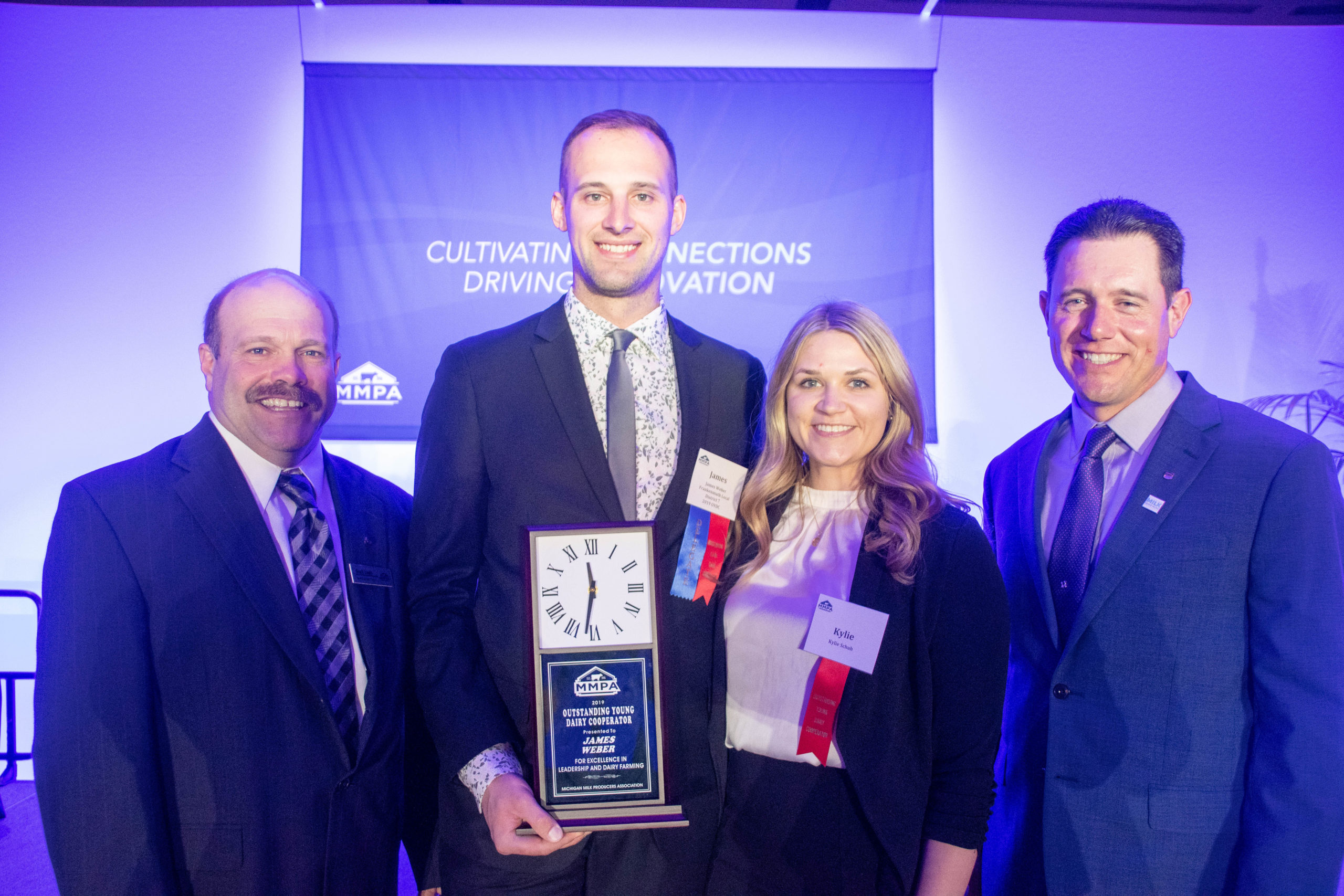
In recognition for his achievements, Weber was recently named the 2019 MMPA Outstanding Young Dairy Cooperator by a panel of judges represented by leaders in the Great Lakes dairy industry. Owner of Weber Family Dairy, he milks 130 cows and farms 800 acres as an MMPA member of the Frankenmuth Local in District 7.

Owning Weber Family Dairy

Before starting the farm, Weber received a dairy management certificate from Michigan State University. An internship sent him to work on a California dairy farm and he stayed out west for a few years working on several dairy farms. He eventually graduated from California Polytechnic State University with a bachelor’s degree in dairy science.

When he returned to Michigan, he knew he wanted to stay a part of the dairy community. But Weber didn’t want to just work on or for a dairy farm, he wanted to own it.

“It always came back to ownership. I don’t like being told what to do or how to do it. And I have that freedom with my own farm,” he said. “When I get something in my mind that I’m going to do something, I’m going to do it.”

The dairy side of the business is one of four entities owned by Weber and his family, alongside Weber Farms, Weber Land and Weber Equipment. Weber’s dad managed Weber Farms with around 40 Holstein cows until selling out in 2011.

“MMPA was the co-op my grandparents joined, the one my dad was with,” he said. “When I started this farm, there was never any thought of a different co-op, it was, ‘Who do I call at MMPA?’”

Owning the Outcome

Weber’s tenacity pushes him forward, but his prudence is driving his success. He keeps his production costs low, makes his decisions based on numbers and uses what he’s learned from mentors to his benefit.

Weber credits much of his knowledge and passion for dairy to his family, his core teachers at MSU and the families he lived with on dairies in California. “I know that I wouldn’t be where I am without their support and influence,” Weber said.

While working on Tollcrest Dairy, a dairy farm in California, Weber developed many of the skills he’s now using to manage his own farm. “That was one of my biggest influence and role model. The owner started his farm off on his own. I learned a lot from him and I’m trying to use what I learned out here.”

Though the buildings are new, the parlor is new, and the farm itself was recently restarted, Weber didn’t go overboard with all the latest gadgets. Instead, he made strategic decisions about where he spent his money and how to sustain his farm with a lower cost of production.

“The only automation we have in parlor is the detachers. We don’t do individual cow milk weights. We don’t have herd management software. I manage the cows on a breeding wheel and excel sheets. It works on small scale,” he said.

If he undergoes an expansion or shifts away from personally managing the cows, Weber says there’s technology he would like to implement. The first step would be to grow his herd to around 400 and then upward from there. When developing the property, he planned out the current structures with an idea of where the next barns would go. But for the moment, he’s waiting until the numbers make sense.

“Following my gut and what I think is right has proven to work for me,” Weber said.

The farm’s mission, Weber says, is to produce a safe, nutritious product. Beyond that, he wants to ensure his employees are happy and that they are protecting the farm’s natural resources.

Weber is continually thinking about how he can efficiently produce quality milk and have a sustainable farm. For example, the cows rest on beds of recycled manure solids. Weber says one day while thinking about his next move and considering how to store his manure for a potential expansion, he noticed his compost pile.

“I was just looking out there at the compost pile. With 130 cows, it was three and a half feet deep. I realized, well there’s my bedding for a future free stall barn right there,” Weber said.

While he ended up putting his expansion plans on hold, his bedding and manure storage solution stuck. And it works without damaging his milk quality results.

“My cows lay on their own manure.  It’s not a low pathogen environment, yet we’re able to achieve good milk quality,” Weber said. “That’s through understanding the relationship to the animal, her health and how somatic cell comes into play.”

An MMPA bronze quality award winner last year, Weber Family Dairy is continuing improving its quality, measured in part by low somatic cell counts.

Owning MMPA

While Weber leads his farm, as a member of MMPA, he also has an ownership stake in the co-op, something he doesn’t take lightly. He’s a delegate for Frankenmuth Local and has served on the resolutions committee, the District 7 nominating committee and as a delegate.

As an OYDC, Weber is hoping it will lead to greater involvement in MMPA. OYDCs often go on to hold leadership positions within their community and cooperative.

Weber attended the initial OYDC conference in August with fellow OYDC finalists. They had an opportunity to look into their cooperative through discussions with co-op leaders and a tour of the offices and milk testing laboratory. Moving forward, Weber will represent MMPA at national dairy meetings, serve an honorary term on the MMPA Advisory Committee and influence the MMPA Young Cooperator program.

Weber says he’s looking forward to representing MMPA, along with enjoying fellowship with members and forging relationships with industry contacts.

“My focus has always been on the farm, being efficient,” Weber said. “So what do you do after you accomplish the things you want on your farm? Well, how do you influence the survivability of your farm beyond just what’s on your farm? You go out and you work in the industry in whatever capacity you can.”

–Allison Stuby Miller

This article was originally published in the September/October issue of the Milk MessengerSubscribe »


After 28 years of pulling up farms’ driveways,

     putting it in park,

          popping open the trunk,

                sloshing sanitizer into a bucket,

                     scrubbing your boots and

                         making your way into the heart of the dairy farm – the parlor –

you know a lot about the dairy industry and you’re especially acquainted with hardworking farmers. Serving as MMPA member representative south area supervisor, Dave Brady understands the effort required to produce high quality milk and is always willing to give a helping hand to MMPA’s producers.

Often working early mornings, late nights and occasional weekends, the culmination of Brady’s dedication and service to the industry was represented in being awarded the 2019 Michigan Dairy Industry Fieldperson of the Year in May. Presented annually at the Michigan Dairy Industry Conference (MDIC), the award serves as recognition for Brady’s outstanding service and as a thank you in an often underrecognized career.

“Dave has served the dairy farmer members in the southeast Michigan area and northern Ohio very, very well,” Gary Trimner, retired director of member services, said. “He has provided the feedback they needed for their operations and has kept farm ratings at a passing level.”

On farms, Brady serves as jack of all trades: cleaning milking systems, writing herd health plans, completing inspections, and helping in whatever way possible. Recently, the changing demand from consumers have led to updates of policies and changes in requirements in the dairy industry. Assisting with implementing these changes has kept Brady busy and his extensive history with MMPA has helped him better understand the needs of the producers he works with.

“We are asking farms to do a lot more now than what they used to,” Brady said. “But instead of saying just do it, we are there to show them how to get to that point. If they need to improve their milk quality, we have services to do that: herds tests, inspections, and wash checks. We aren’t asking them to do anything that we can’t help them with.”

Prior to working with MMPA, Brady worked at Southern Milk Sales, a cooperative in Indiana that had Brady completing many of the tasks he does daily now. This experience, along with knowledge gained working at Hygeia Dairy Company, a bottling plant in Corpus Christi, Texas, let him see the “other side of cooperatives”.

The well-rounded experience paired with his dairy science degree from Michigan State University allows Brady to be any farm’s hands-on investigator – able to diagnose problems and present solutions all in the name of improving milk quality and helping the farmer’s bottom line. Brady is most often called on by farmers asking for help decreasing their somatic cell count, a key milk quality indicator that correlates with levels of infection and can impact the amount of milk premiums they receive.

“If I visit somebody that really wants help getting their somatic cell count down, and we identify and correct something in their operation so that they get it down, they are so happy that they can earn premiums and that they corrected the problems,” Brady said. “There is a lot of enjoyment from knowing that because we were out there and we helped them, now they’re doing better than they were before. And right now, if they are not making all their premiums, with the price where it’s at, they need to be.”

MMPA calls on member representatives to build relationships with members to better serve them during the challenging times the dairy industry has experienced. Brady recognizes the importance of his job and his fellow member representatives, especially when milk prices are low, and the industry is rapidly changing to meet the demands of consumers.

As of 2016, MMPA members have been required to enroll in the FARM (Farmers Assuring Responsible Management) animal care program, a national third-party verified animal care and welfare program. Prior to that, the MAEAP (Michigan Agriculture Environmental Assurance Program) became a voluntary certification that farms could obtain to implement agricultural pollution prevention practices.

In response to new programs and a change in members’ needs, MMPA member representatives serve as teachers during interactive trainings like Dairy Care Academy, as motivators to ensure that MMPA’s customers’ standards are met and occasionally as shoulders to cry on and a person to vent to when everything gets to be too much.

“Sometimes, we are the bartender,” Brady said. “We hear the problems, and there’s not a whole lot we can do about it. I can help them get their premiums, but I can’t do a thing about the price.”

The tremendous role member representatives play on members’ farms and in the dairy industry as a whole makes them a valuable part of the team. Although recognition is often scarce, the Michigan Dairy Industry Field Person of the Year award serves as a thorough thank you for the time, the effort and the helping hand they provide in an industry that is the backbone of Michigan.

–Emily Kittendorf

This article was originally published in the July/August issue of the Milk MessengerSubscribe »

The spring of 2019 will be remembered as one of the toughest on record to get crops planted and first cutting hay harvested. Farms across the Midwest struggled with untimely rains, flood watches and tornados and even the shrewdest of operators found themselves facing the close of planting season with half of their crop in the ground and wondering what the future would hold. Add this to a struggling dairy economy and the future looks bleak for anyone who is producing milk for a living.

“When things are difficult and it’s one of those tough days or weeks, there are two things that keep me focused; faith and family,” Darwin Sneller, MMPA member from Sebawaing, Michigan, said. “I believe that the Good Lord choose us to be dairymen and farmers. We are a special group of people who deal with more uncertainty than any other occupation and yet are relied upon to feed the world.”

Darwin and Kathy Sneller own and operate Starward Farms, in partnership with Kathy’s brother, Walter Gremel, and son and daughter-in-law Eric and Cassie Sneller.

“There have been plenty of tough times but never this length of time and every commodity we deal with, in the dumps, all at once,” Sneller said. “Now this spring we have been dealt the toughest planting season, being drawn out over three months and still there is a lot of ground which did not get planted. What does this hold for a poor dairy economy? Stay tuned because I don’t think anyone knows.”

As of June 9, only 3.5 days this year had provided proper conditions for field work in Michigan. About 63 percent of the state’s corn crop had been planted, down from 88 percent on the same date in 2018. Less than half of the soybean crop had been planted.

Richard and Trula Thomas milk 100 cows in Middlebury, Indiana with their son Sheldon. They purchased the farm and have been producing milk for 40 years.

“I’m committed to this lifestyle. I knew it was going to be bad at times and maybe I’m too much of an optimist but I’m hoping things will turn around quickly,” he said.

Thomas flat out admits that he enjoys milking cows and that’s what has kept him rising every morning to take care of his Registered Holstein herd. “I keep thinking that things are going to turn around and it has turned around somewhat, but it needs to get a lot higher and stay there.”

Hindsight is 20/20 and Thomas thinks that he should have sold out in 2008 when the cows were worth more and before the dairy prices went south in 2009. Now ten years later the dairy economy stifles his ability to make updates on the farm.

Both Sneller and Thomas have a keen focus on improving the genetics in their Registered Holstein herds. Both have bred and developed cows through the years that have garnered awards and banners in the show ring and the bulk tank. This focus has given them a spark to wait out the down markets and keep moving forward. Sneller commented, “The simple things are the most therapeutic and satisfying. That new heifer calf, that cow scoring excellent, placing high at the shows, are all things that give pride and accomplishment in your work.”

Family is paramount in tough times, Sneller explained. “On those tough days, it’s the little things that pick me up. My wife can give me a hug and a kiss on the cheek and say, ‘it will be okay.’ Your kids or parents are there to help and give a kind word. And of course, there are the grandkids,” Sneller said. “It can be a tough day and the grandkids in Maine call and just make you forget the problems. Or the 2-year-old who jumps out of his moms’ arms to get a ride with grandpa in the tractor, always brings a smile.”

Thomas believes that resiliency to stay in the dairy business is a must, but not everyone has it.  When asked what advice he has for any young person jumping into the dairy business he replied with a chuckle, “Make sure you have a rich uncle.” He looks forward to the dairy economy picking up while he continues to develop their herd and market their elite genetics.

In the foreseeable future, Sneller says their farm is solid, “We have been able to do what we need to, in order to stay progressive. There are changes we have talked about, but we need for prices to pick up to make them feasible.”

Sneller also offered his two cents worth of advice for the younger generation, “A young person wanting to get into dairy farming needs to be connected with their family or as a valued herdsperson on an existing dairy. They have to have cow sense and financial smarts, unless they have won the lottery.”

Resilience is required to survive in this business, according to Sneller, “As far as being resilient, you have to be. Stuff always happens. You just deal with it, learn from it and move on. The sun comes up tomorrow.”

Sneller concluded, “I don’t have any magic answers in these difficult times, but keep a positive attitude and find ways to keep things light. Smile and laugh, it is contagious.”

–Melissa Hart

This article was originally published in the July/August issue of the Michigan Milk MessengerSubscribe »