Michigan State University (MSU) researchers have been studying tar spot in corn fields since its first appearance in Michigan in 2016.

Tar spot is a corn leaf disease capable of causing severe damage to infected crops. Dr. Martin Chilvers and graduate student Peyton Phillips at MSU have been diligently researching this fungal disease and educating producers on effective management strategies.

“We had severe epidemics in 2018 and 2021,” stated Dr. Chilvers. “The fungus thrives in cool, wet conditions. Disease modeling work with colleagues at UW-Madison has resulted in an improved understanding of the conditions and the development of the Tarspotter app which is a decision support system, that helps to predict conditions favorable for disease development.”

Frequent moisture events and increased awareness have led to early detections of tar spot across the region, including Michigan, in the 2024 season. While warm July conditions slowed its progress, tar spot is now easier to find into August and September, with disease pressure increasing in some fields. Weather conditions for the rest of the season are going to be key to its development.

Identifying tar spot

Tar spot is caused by the fungal pathogen Phyllachora maydis. P. maydis and can only infect green corn tissue. The fungus survives on infected corn residue through the winter and releases spores in the spring
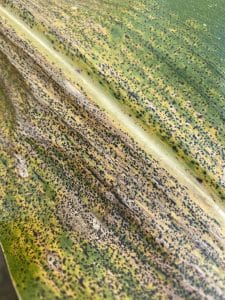
Tar spot on corn leaf.

that can infect new plants. It is not seed transmitted, though can be moved on infected leaf tissue.

“We map tar spot every year and from this work we can see it’s travelling 10’s of miles per season, including moving into states where it has not previously been reported. It produces many spores that become airborne and are carried by the wind,” explained Dr. Chilvers.

It is reasonably simple to identify tar spot as the lesions are relatively distinct, consisting of a matte black raised spot that is embedded within the leaf and will not rub off the leaf surface. Tar spot thrives in cooler, wet weather conditions, so it is important to be scouting fields during these conditions.

“It is very important to be checking your fields, especially when weather conditions are favorable for the fungus,” stated Dr. Chilvers. “Fungicide cannot be applied as a preventative measure, and once a field is infected the disease can spread quickly.”

Bug feces, scientifically called insect frass, are often confused with tar spot, however these are easy to distinguish as frass will dissolve and wipe off the leaf with some water, while tar spot will not.

“If farmers are unsure whether tar spot is present in their fields, they can send a sample into the MSU Plant and Pest Diagnostic Services,” Dr. Chilvers stated. “Occasionally other diseases are confused for tar spot, we’ve even had fields unnecessarily sprayed when bug poop has been mistaken for tar spot, so be sure of your diagnosis.”

It is important to identify tar spot as early as possible as it can result in rapid dry down of the plant and result in decreased nutritional content compared to a healthy disease-free plant.

“The disease can rapidly dry down the corn plant and result in lost starch,” Peyton explained. “With the rapid dry down yields are reduced and the lignin increases as the starch content is reduced.”

Tar spot is not known to produce any mycotoxins or cause harm to ruminant animals during digestion. However, under high disease pressure, tar spot can overwhelm plant defense responses leading to the rapid dry down of the crop, resulting in lower yields and a reduced nutritional content.

Managing Tar Spot

Use of hybrids with tolerance/resistance to disease is the cornerstone of disease management. A hybrid with partial resistance to tar spot will greatly help slow disease development and has the potential to negate the need for a fungicide.
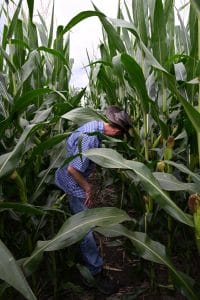
Dr. Chilvers scouts corn field for tar spot.

“Unfortunately, no hybrid is immune to tar spot, but there is significant variation in hybrid susceptibility”, stated Dr. Chilvers. “If you want to minimize damage from tar spot it is very important to select a corn hybrid with tar spot resistance.”

It is not recommended to use tillage as a preventative management practice. Although tar spot does survive on residue, the spores can travel many miles in the wind, negating any benefit from tillage.

Dr. Chilvers explained, “In the severe tar spot epidemic years of 2018 and 2021 there were numerous fields that hadn’t been in corn for years that were severely impacted by tar spot.”

Any value in tilling fields will be short lived as spores blow in from outside fields. Crop rotation is an important tool for disease and insect management, however, variety susceptibility and weather conditions play a much larger role in disease development.

“If you practice crop rotation it doesn’t mean you’re going to escape tar spot because it can blow in from outside,” stated Dr. Chilvers.

Tar spot can rapidly dry down the plant to the point where it can no longer be harvested or is missing vital nutritional content. When considering harvest timing it is important to scout fields to know the severity of the disease during a given growing season. Always remember to check pre-harvest intervals after making a fungicide application as most fungicides need to be applied 30 days before silage harvest.

Fungicide Application

Depending on the timing of disease onset and weather, a fungicide application somewhere from VT/R1 (tassel and silking) through to R3 (milk) is typically the best timing. Early vegetative applications tend to have little effect on suppressing tar spot epidemics and later timings might interfere with harvest if the pre-harvest interval is too long. Applying fungicides at the VT/ R1 growth stage is also ideal for mycotoxin suppression in silage, however, could possibly be too early for optimum tar spot control depending on the year and disease pressure.
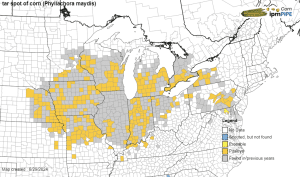
MSU continues efforts to develop data sets to train and test the tar spot disease forecasting app “Tarspotter” developed with colleagues at the University of Wisconsin-Madison. The Tarspotter app is free to download and can be found on smartphone app stores (a version is also available via Field Prophet). Tarspotter can be used to assess tar spot disease risk based on weather variables for multiple pinned locations within the app. When using the app keep in mind that is still important to scout fields to see if disease is present and be mindful of crop growth stage. Funding for this work was also made possible by the Corn Marketing Program of Michigan and the National Predictive Modeling Tool Initiative through the USDA.

Dr. Chilver warns, “Although we have seen greater disease suppression with two fungicide applications, this is not always profitable. In fact, some years a fungicide may not be needed. In general, we recommend the use of a fungicide product with mixed modes of action, this typically provides better disease suppression than a single mode of action product.”

Dr. Chilvers and his team are also weary of the development of fungicide resistance in the tar spot fungus. By using a mixed mode of action fungicide, it should slow the development of fungicide resistance.

“Each year we conduct fungicide efficacy trials to assess current and new products and combinations,” Peyton described. “We have tested various fungicide products and there are a couple that do perform a little bit better, but really it comes down to application timing. That’s the more important factor.”

If you do decide to make a fungicide application, be sure to leave check strips and pencil out the costs and benefits, otherwise you will never know what your return on investment is.

POWERED BY PARTNERSHIPS

The Michigan Alliance for Animal Agriculture (MAAA) is a partnership among the state’s animal agriculture industries and MSU focused on advancing the Michigan animal agriculture economy. MAAA’s partnership with MSU allows scientists such as Dr. Chilvers and his team to continue researching relevant crop diseases in Michigan.

“Sample analysis testing can be very expensive, so without the help of MAAA none of this would be possible,” said Dr. Chilvers. “We’ve generated an awful lot of data through analysis testing, which has been really cool. Now we’re just working through getting it organized and analyzing it for publication to share with the growers.”

MMPA is proud to partner with MAAA to support research, extension and seed grant projects that will enhance Michigan animal agriculture.

This article was originally published in the September/October 2024 issue of the Milk Messenger. Subscribe »
MMPA is committed to cooperative social responsibility and sustainable business practices throughout our entire supply chain. At the farm level, MMPA members are also on a sustainability journey. We’re checking in with a handful of member farmers leading the charge with this sustainability spotlight series. 

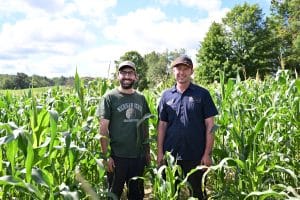
Eric Martin and Brandon Gingrich

When we talk about farm sustainability, we often overlook the most crucial element—the sustainability of the farmer’s own well-being. On Gingrich Meadows Dairy, in Leroy, Mich., they are continuously looking ahead and trying new things to not only make their farm more sustainable, but their quality of life better.

Brothers Eric Martin and Brandon Gingrich are on the same page when it comes to their definition of sustainability. “Sustainability is maintaining practices that allow you to continue operating your business with no end date. That’s for the animals, the land and quality of life,” stated Brandon. Eric added, “You also have to practice things that work for you. You need to sustain your land, because if it’s not profitable or your cows aren’t profitable, you’re not going to have a great quality of life. Happy cows make milk, so you have to keep the cows happy.”

The farm has made it a priority to reduce the amount of labor needed for it to operate. In 2012, eight robots milked 450 cows, but not in an efficient manner, so in 2016 two 16-stall parlors replaced them. Fast forward to February of 2024 and the farm replaced the 16-stall parlors with eight robots.

“The 16-stall parlor didn’t work for us,” stated Brandon.

“We couldn’t keep employees in the parlor and the parlor was starting to be unreliable,” added Eric. “With robots there is a higher level of job satisfaction. With more content employees, the cows are happier.”

There is also a level of consistency with robots that Gingrich Meadows appreciates.

“There is consistency every single time with the robots,” Brandon said. Eric added, “We’re not getting different prep and lag times or different teat dip rates. There is no challenge with teaching employees the importance of proper prep procedure. Cows also go undisturbed most of the day and they’re not being pushed into a hot holding area.”

The implementation of activity monitoring collars in 2012 has also saved the farm a great deal of labor.

Eric described, “Our heat detection system helps us breed off of more natural heats. We’re not synching up cows all the time and giving as many shots, which is also labor intensive and expensive. We have also noticed since the robots have been installed that our heat detection has increased.”

Gingrich Meadows cares a lot about the welfare of their cows and has made great efforts to produce quality forages that benefit the animals’ gut health.

“For five years now, we have been trialing alternative forages to replace alfalfa. We spend four weeks out of the year chopping and putting up alfalfa, so to improve our quality of life and the digestibility of the forage, we explored alternatives.”

Alternative forages have been effective in improving the farm’s time management and animal welfare, while also allowing the added benefit of double cropping.

“Mastergraze is a tillering corn with many shoots that acts like corn when you plant it, but feeds like sorghum. We have fed it for three years now and it has increased digestibility by 25-30% compared to alfalfa. We have also had success with a male sterile forage BMR sorghum Sudan grass. One of the reasons we like the alternative forages is that it treats the cow’s gut better. We do get less pounds of milk in the bank, but we don’t burn them out and we maintain elevated butterfat and protein levels,” Brandon explained.

Although the alternative forages are annual crops, the farm spends less time in the field and are able to harvest a second crop.

Brandon stated, “You can double crop with it so we’re actually getting more tons per acre than alfalfa. Our goal is to always have a living plant in the soil to tie up the carbon, which is how we’re using cover crops- to help build the soil and to feed the next crop.”

The farm has also experimented with biologicals that have significantly reduced their need to add nitrogen and urea to their fields.

“We’ve done some test strips with biologicals, and we’ve gained nitrogen in our fields right out of the program. It’s allowed us to reduce the need of urea fertilizer,” stated Brandon. “Resources on Earth will not be here forever, you’ve got to find ways to be sustainable and biologicals are something we utilize to be sustainable.”

For many generations Gingrich Meadows have been on the forefront of trying new things and being progressive. Brandon and Eric agree, “That’s part of sustainability, you have to do what works best for you. Just because that’s the way it’s been done for the last 60 years doesn’t mean that’s how it has to be done today.”

KEYWORD

Biologicals: Crop protection and seed treatment products derived from living organisms, natural materials, or naturally occurring processes. They are used in agriculture to improve the health of food crops and protect them from pests, diseases, and weeds.

Forage sorghum: A type of sorghum that’s been bred for forage production and is often used as an annual hay or forage crop. It can be used as a cover crop to prevent soil erosion and improve soil fertility.

SOURCE: U.S. Department of Agriculture

FARM

Gingrich Meadows Dairy
Leroy, Michigan

HERD

450 milking cows

LAND

1,500 acres of corn, alfalfa, rye, and forage sorghum

VERIFICATIONS

MMPA sustainability survey, FARM* Animal Care and FARM* Environmental Stewardship evaluations, Comprehensive Nutrient Management Plan, and Michigan Agriculture Environmental Assurance Program verified.

This article was originally published in the September/October 2024 issue of the Milk Messenger. Subscribe »

By Brad Parks, MMPA Director Strategic Initiatives

The Dairy Distillery Alliance project in Constantine, Mich., is making significant progress. Our early August groundbreaking event officially marked the start of construction, allowing us to recognize and celebrate our partners and vendors who are turning this concept into reality.

The project will include America’s lowest carbon-intensity dairy ethanol plant and a wastewater treatment plant. The ethanol plant will convert milk permeate, a byproduct of ultrafiltered milk, into two million gallons of ethanol per year. The wastewater treatment plant will manage the waste stream from both MMPA’s Constantine processing facility and the new ethanol plant.

There were many key partners that assisted with the project to make it all come together from partners with expertise in wastewater equipment systems, designing and building the distillation equipment, general contractor, lending partners, legal and a bank who specializes in USDA-backed financing.

Since December 2023, we’ve been working on the engineering and design for the wastewater and distillation systems, and we began environmental testing and permitting in January 2024. Construction officially started on July 6, 2024, with site work and foundation phases now underway. The distillation tanks are scheduled for installation by the end of August, followed by the buildings. We plan to have the wastewater plant operational by the end of December 2024, with the ethanol distillation expected to come online by June 2025.

We’re currently in the process of hiring a plant manager to oversee operations as construction wraps up. The plant is expected to employ 10-13 people and will operate 24 hours a day, seven days a week.

Originally, the project’s revenue model focused on selling liquid ethanol as an energy source for the vehicle fuel market. However, we’ve since identified a promising opportunity to partner with Lanza Jet, which is pioneering the production of low-carbon jet fuel. This partnership could become a significant part of our long-term strategy.

Throughout this process, we’ve engaged multiple departments within the Michigan Milk Producers Association, including the Constantine team, plant engineering and operations, accounting and finance, human resources, and government relations and communications. We appreciate their support and the support of our member owners.

The excitement is building as we move closer to making this project a reality. Thank you to everyone involved for your vision and support in bringing value back to the dairy farm and contributing to a sustainable future.

This article was originally published in the September/October 2024 issue of the Milk Messenger. Subscribe »
A nearly old as time process that begins with fermentation, is going to help cows reach the sky. What started as a solution to upcycle milk permeate, a byproduct of the ultrafiltration process, became an answer to improving dairy farmer’s economics and contributing to the dairy industry’s sustainability goals. The unique solution was the result of an unlikely partnership between a Canadian-based vodka company, Dairy Distillery, and America’s 10th largest dairy cooperative, the Michigan Milk Producers Association (MMPA).

“At the time when MMPA reached out to us looking for a better value from their byproduct, we were making vodka from milk permeate,” Omid McDonald, Dairy Distillery Founder & CEO said. “After some phone calls and meetings, we realized that the amount of permeate that MMPA’s Constantine, Mich. plant produces would yield millions of bottles of vodka which would be hard to sell. We then turned to look at using permeate to make biofuel. That’s where this project came from.”

While the volume of vodka would have flooded the market, there is a strong need for low-carbon biofuel. From the idea’s inception, pieces of the puzzle have continued to come together.

“The ability to solve a problem for milk permeate and create a way to add value was the first win,” Brad Parks, MMPA Director of Strategic Initiatives explained. “The second is that the project let us build a state-of-the-art wastewater treatment plant that will use the biogas produced when manufacturing low carbon fuel to fuel the treatment processes.”

The new wastewater treatment facility removes the Constantine plant’s reliance on the municipality’s wastewater treatment facility and lets the new plant be run nearly carbon neutral. The only question that remained, was cash flow.

“I wondered how competitive we were going to be on the revenue side of ethanol,” Parks added. “But then the opportunity came along where the airline industry expressed interest in utilizing all of the ethanol that we would produce for sustainable airline fuel. That became the third win. Our revenue side is locked up long term and we have a more secure economic model.”

The win-win-win will benefit MMPA’s member owners and has resulted in breaking ground on the lowest carbon dairy ethanol plant in America. The success of the official groundbreaking of Dairy Distillery Alliance’s 2.2 million gallon ethanol plant in August though, didn’t come without its challenges.

Jumping Through Hoops

“It’s been a lot more complicated than what we envisioned,” Parks said. McDonald added, “I call myself a seal, used to jumping through hoops, but this is a big project. We knew it wouldn’t be simple. It’s a first of its kind, it’s something new, but what we are doing together in Constantine is worth all the hassle.”

The list of what they both consider red tape includes securing grant money, partnering with agencies and contractors, and working with state and federal agencies. Thanks to teamwork between the two organizations, the red tape is behind them.

“Dairy Distillery brings the distillation expertise on operating an ethanol plant, and we’re bringing the ability to generate milk permeate, which feeds the plant,” Parks said. “We both bring expertise and knowledge to the partnership that the other doesn’t have.”

The partnership between Dairy Distillery and MMPA may seem happenstance, but Parks is quick to point out that “our organization has a desire to innovate and look at things in a new way, diversify what we make and expand our footprint. We’re always on the lookout for opportunities. That goes a long way. You can call the project luck, but you can also say we were on the lookout for that.”

Science As Old As Time

Despite the new and unique use of the Dairy Distillery Alliance innovation, when it comes to the distillation process to produce the ethanol, the milk permeate ethanol plant relies on science experimented with during the 1970s oil crisis.

“The process is almost as old as mankind,” McDonald explained. “With fermentation, the yeast we have eats the lactose, converts that into alcohol and then we use standard distillation to purify that alcohol to ethanol. From there, it can be used in cars or in planes.”

In Constantine, 14,000 tons of milk permeate will be piped under the road from the dairy plant to the ethanol plant annually, requiring no additional transportation. From there, the permeate will fill fermentation tanks before going onto to be distilled. The distillation process requires heating the mixture of water and alcohol until the alcohol vapor evaporates through the still. Then, it gets dehydrated to 99 percent alcohol. The final product will be sent via rail car to become sustainable aviation fuel.

“Constantine’s dairy-based ethanol is going to power planes and milk permeate has the potential to reduce the carbon footprint of air travel by 50%,” McDonald said. “This project is part of the dairy industry’s bigger message that dairy is sustainable and getting even more sustainable. Dairy production’s carbon footprint in the U.S. has been decreasing consistently for a decade, and this is just one more step.”

The Sustainability Story

The low-carbon ethanol plant will offset 14,500 tons of carbon a year, equivalent to 5% of Constantine’s carbon footprint for milk processing.

“Traditional gasoline emits 88 grams of CO2 for every megajoule of energy it produces, corn ethanol emits 55 grams of CO2 per megajoule, and Constantine’s ethanol is going to be around 12 grams of CO2 per megajoule,” McDonald explains. “Because the grass that the cow ate was carbon that was captured when the cow eats it, we capture that sugar, so essentially the ethanol is taking the carbon out of the atmosphere and putting it back in, so it’s neutral, and that’s the goal.”

An artist’s rendering of the upcoming Dairy Distillery Alliance facility in southwest Michigan. This $41 million plant will convert milk permeate, a dairy byproduct, into 2.2 million gallons of ethanol annually, significantly reducing carbon emissions and advancing sustainability in the dairy industry.

The sustainability message is one that MMPA is carrying forward. Beyond being good for the environment, the value-added ethanol also provides a diversified revenue stream that will benefit member-owners.

“This project shows how we can turn environmental responsibility into an economic opportunity,” Joe Diglio, MMPA President & CEO said. “By converting milk permeate into ethanol, we’re not only upcycling a dairy byproduct, but also creating a new revenue stream for our member-owners. This project is a win for the environment, a win for our cooperative, and a testament to our commitment to leading the dairy industry into a more sustainable future.”

The ethanol plant is expected to be in commission mid-2025, while the wastewater treatment facility is on track to begin operation by end of the year. Looking to the future, McDonald and Parks are excited about the possibilities.

“It takes someone to take the first step and MMPA has done that in Constantine,” McDonald said. “Others are now looking at doing the same at their facilities. The need for low carbon energy is one that’s just going to grow, and the amount of milk permeate being produced across the world is growing as well.”

McDonald added, “Once we have shown that we can make a value for MMPA and achieve the carbon reduction that we’re on target to achieve. Then, the sky’s the limit.” Quite literally. What started as McDonald’s self-considered “far-fetched idea” has turned around and proved the impossible. “I never thought cows would fly.”

This article was originally published in the September/October 2024 issue of the Milk Messenger. Subscribe »

Tegan Schott

Walled Lake, MI

Internship: Human Resources
College: Michigan State University
Year in School: Incoming Senior
Major: Advertising Management, Minor in Professional and Public Writing
Dream Job: Executive Media Planner for Ford Motor Company

What previous experiences do you have that have helped prepare you for your internship?
My classes have greatly prepared me for this internship, even though my hands-on experience in HR is limited. The tasks I’ve worked on—such as presentations, policy writing, infographics, and handbook revisions—align closely with my coursework. Last semester, I took a writing class focused on drafting policies and enhancing a company’s media reach and communications. It’s been incredibly beneficial, and it’s great to be able to apply those skills in this internship.

How does this MMPA internship experience fit into your future career goals?
Even though I know what I eventually want to do, I’m not exactly sure what my next steps are after graduation. This internship is perfect because it gives me experience in my field while letting me explore different areas.

What was your favorite experience working as an MMPA intern?
I genuinely loved meeting everyone and making new friends. The people in the Novi office can attest to how I’ve made an effort to connect with everyone. Being naturally social, I find it inspiring and incredibly helpful to meet so many people who are passionate about their work, as it helps me figure out my own career path.


Trevor Paparella

Brighton, MI

Internship: IT Technician level 1
College: Michigan State University
Year in School: Junior
Major: Computer Science
Dream Job: Working in cyber security, penetration testing

What previous experiences do you have that have helped prepare you for your internship?
I had an internship last summer working in IT.

How does this MMPA internship experience fit into your future career goals?
It helps me gain more experience in IT, which is a steppingstone to getting into cyber security.

What was your favorite experience working as an MMPA intern?
Going to visit the plant down in Middlebury. It was cool to see the process of how the cheese is made.


Ella Cloud Schneider

Caro, MI

Internship: Health and Safety Intern
College: Michigan State University
Year in School: Senior
Major: Animal Science, with a concentration in Dairy Industry
Dream Job: Working in the dairy industry, preferably with genetics/reproduction

How does this MMPA internship experience fit into your future career goals?
My goal this summer was to do something different, this internship provided me with that opportunity. I have been able to experience another area of the industry.

What do you like most about working in the dairy industry?
The people! Whether I am here working at MMPA or out working with a dairy farm during class time, I love seeing the passion people have for this industry. It is so inspiring to see people be proud of what they have worked for and continuously strive to do better.

What was your favorite experience working as an MMPA intern?
I love being able to see a different part of the industry that we do not get to cover enough in school. In just the first couple of days here I was able to learn so much about all the different processes in the plant.

Martin Grinnell

Lake Isabella, MI

Internship: Accounting/Finance
College: University of Michigan
Year in School: Junior
Major: Business Administration
Dream Job: 100% Grass Fed, Organic Dairy Producer

What previous experience did you have that helped prepare you for your internship?
Working as a farm hand for one of our producers when I was in high school gave me crucial insight into how the dairy industry operates. I think it’s important to have a good understanding of the entire “life cycle” of milk when you work in the industry, and having years of hands-on experience with the first step in the process has proven invaluable during my time here.

How does this MMPA internship experience fit into your future career goals?
I believe that having a solid understanding of accounting is incredibly valuable no matter what business or business function you work in. I once was told by a lifelong dairy farmer that farming is first and foremost a business. Being that accounting is often referred to as the language of business, becoming fluent in it is incredibly important to me.

What do you like most about working in the dairy industry?
Without a doubt the most rewarding part about working in the dairy industry is knowing that the work I’m doing will benefit dairy farmers and the dairy industry in some way. Dairy farmers are some of the most hardworking and kind people I have ever met. Anytime I can do something to give back, I am beyond happy to do so, whether it’s in the milking parlor, behind the wheel of a tractor, or in the office.

Riley Simmons

Chesterfield, MI

Internship: Food System Fellowship
College: Michigan State University College of Veterinary Medicine
Year in School: Rising Senior Year
Major: Doctorate of Veterinary Medicine
Dream Job: Large Animal Veterinarian

How does this MMPA internship experience fit into your future career goals?
This internship opened me up to the world of regulatory work which provided me a new opportunity to scope out for when I am finally able to practice as a veterinarian. Working with regulatory agencies from co-op to state inspectors is an important aspect of being a veterinarian, especially one who wants to work with biosecurity regulations. My ability to take charge of being the biosecurity expert for the field representative team has provided me more opportunities to build my communication skills and learn more about how producers think regarding their disease management protocols which I can take back with me to build better relationships when I become a veterinarian.

What do you like most about working in the dairy industry?
I have loved getting to know producers and learning more about the regulations on how to ship milk.

What was your favorite experience working as an MMPA intern?
My favorite experience has been working with field representatives like Emily Patton to help producers learn more about biosecurity and how they can start implementing plans on their own farms.

In 1981, straight out of high school, Dave Davis did not expect that his part-time job at MMPA would lead to a lifelong career of serving the dairy industry. Working at MMPA’s Constantine, Mich. plant with his father was only a means to get him through college, but 43 years later he finds himself in a leadership role as Constantine’s Plant Manager. Dave was recently recognized with the 2024 Industry Service Award for his dedication to Michigan dairy farmers.

“I worked here part-time while taking classes at Southwestern Michigan College. I became an evaporator operator, separator operator and post-graduation I went into management as a supervisor, then a production manager and now plant manager,” said Dave.

He has gained extensive experience working in various departments of the plant and has remained dedicated to his roles, finding the work at the plant highly rewarding.

“It’s satisfying to provide a wholesome food source like dairy products,” Dave shared. “You get to help our members deliver their product to market, and I have always found that very rewarding throughout my

Dave Davis and his wife, Cindy, accept the Industry Service Award at the 2024 Michigan Dairy Industry Conference.

years of working in Michigan.”

Finding fulfillment in his work, Dave relies heavily on his team members, with whom developed strong relationships.

“I am most proud of the team members,” Dave said. “There’s always been a great, very dedicated team here at the plant. A lot of people have been here for a substantial amount of time, and we’ve formed friendships from working together every day to make sure that we do what we’re supposed to do.”

The team at the plant works diligently to ensure they process a safe, high-quality product while also prioritizing their own safety.

Dave stated, “Every day when I come in, I’m strongly focused on food safety and human safety. We have received awards in the past for safety and right now we’re at 950 days without a recordable injury. We are very proud of that.”

During his time in Constantine, Dave and his team have witnessed the plant’s growth and are continuing to prepare for further expansion.

“All through my career, there has been constant growth of this plant. When I first started here, we processed 400,000 pounds of milk a day, now we can process 3 million pounds. The tanker trucks have gotten bigger, they were just straight trucks when I first started here, and now, they’re super tankers that haul 100,000 pounds of milk at a time.”

Dave has watched the Constantine plant grow and sees the same future for Michigan’s dairy industry.

“I envision that the industry will continue to grow, and we see new products developed,” said Dave. “I can imagine more diversification from the traditional commodity market. An example of this is how MMPA has partnered with GoodSport. We’re going from just marketing whole and skim milk to a sports drink that is similar to Gatorade.”

The plant’s most recent expansion, and Dave’s greatest personal achievement at MMPA, was the two million pounds of milk per day ultra-filtration system addition in the fall of 2018.

“That was an exciting project. We needed to have an outlet for more of our members’ milk and as a team we came up with the concept of ultra-filtered milk. It took about six months to build that whole plant and that gave us an additional two million pounds of capacity,” stated Dave.

MMPA continues to grow the plant’s facilities as the Dairy Distillery ethanol-processing plant is set to break ground this summer. One of Constantine’s very own engineers came to Dave with the idea of recycling the plant’s milk permeate byproduct.

“I’ve had involvement on the conceptual idea of the Dairy Distillery plant,” said Dave. “We have a plant engineer, Jesse Mahoney, who found the Dairy Distillery in Ottawa, Canada that was making vodka from milk permeate. At the time we were looking at ways to control cost on the lactose byproduct, so we explored that idea and here we are, set to break ground in August.”

Dave has great experience with the plant, helped it grow and thrive, and he foresees MMPA continuing to be a strong company in the future.

“In 20 years, I think MMPA will still be a strong cooperative,” stated Dave.

It is for that reason Dave was honored as the 2024 Industry Service Award recipient during the Michigan Dairy Industry Conference held in May 2024. The award recognizes individuals who have made significant contributions to Michigan’s dairy industry.

“Everybody in the cooperative has helped me get this far. There is great support within MMPA, and as new people come and go, you learn from their past experiences and that’s how I got to where I’m at,” Dave shared. “I was surprised to receive the award – surprised and very appreciative.”

This article was originally published in the July/August 2024 issue of the Milk Messenger. Subscribe »

Michigan Milk Producers Association (MMPA) members recently elected Amy Martin to serve a three-year term on the MMPA board of directors as a District 3 Director. Martin joins the 12 other dairy farmers on the MMPA board of directors, helping guide the direction of the cooperative and setting strategic goals.

Martin began farming on her family farm, Gingrich Meadows in LeRoy, Mich. in 1989. Today, with her husband Craig and two children Eric Martin and Brandon Gingrich, they manage 1,600 acres of farmland and 500 milking cows on their dairy. She’s been active in MMPA for many years, previously serving on the MMPA Advisory Committee and as a local secretary. She’s also an MMPA Dairy Communicator and served on the MMPA Restructuring Task Force.

How has MMPA impacted your farm?

MMPA provides a reliable and consistent market for our milk. I never have to worry about the milk check as I trust that it’s always going to be deposited in the bank on time.

What do you value most about MMPA?

The staff is very important. The services that they provide such as the milk sampling, wash system analysis, etc. help with the farm management program and that is invaluable.

Why did you want to join the board of directors?

I’ve spent my entire life on a dairy farm and have a strong love for the dairy industry. I was born and raised on one, and now, with the help of my husband and two sons, I run my own dairy farm. I’ve always been very active with Michigan Farm Bureau and MMPA, serving on a lot of committees and I’m at a time in my life that I now can take on a bigger role with the board of directors.

What are your goals and vision while serving on the board of directors?

I believe that a board member should first observe and learn what their board position is expected to do. With my leadership experience throughout the years and serving on various committees, I know I can bring a lot of ideas and opinions that will help serve the co-op.

What would you tell members looking to become more active within the cooperative?

I always encourage people at the district meeting to get involved. You can join CORE programs, be part of the Legislative Group or participate in virtual meetings. MMPA has made it very easy for people to be involved, and I think it’s part of members’ best interests to know what’s going on within their co-op.

This article was originally published in the July/August 2024 issue of the Milk Messenger. Subscribe »

MMPA is committed to cooperative social responsibility and sustainable business practices throughout our entire supply chain. At the farm level, MMPA members are also on a sustainability journey. We’re checking in with a handful of member farmers leading the charge with this sustainability spotlight series. 

From humble beginnings first-generation farmer Trent Stoller has grown his dairy legacy from 700 to 11,000 cows across five dairies in northwest Ohio. Coming from a family in the plastics business, Trent knew little about the dairy industry when he purchased his first farm of 700 cows in 2008, but has since proved himself business savvy as GreenTop Acres is now a thriving dairy enterprise.

Trent attributes much of his success to the people around him. He believes not only in environmental and financial sustainability, but the idea of having sustainability within your workforce.

“I am most proud of our people,” Trent said. “We would like them to view their job as not just a stepping-stone, but a career with retirement. I do believe that when we think long-term or sustainable, it has a very positive spillover in our personal life and the way we treat people.”

Trent places great value in taking care of his employees and has taken advantage of technology to help manage schedules better.

“It dawned on us that all our employees have a phone, so we utilize the cloud for everything. All our procedures, contact information, tracking, packing lists, scale-in scale-out, etc. is in the cloud so at anytime, anywhere, employees have that information.”

Not only can employees access key information on the cloud, the farm also uses the technology as a daily management tool.

“We have implemented task lists inspired by military training, where decisions are made in advance,” described Trent. “This approach allows our team to react based on predefined plans without needing to figure things out on the spot. Each morning, our guys and gals simply check their list, guiding their tasks for the day. This system also eases transitions during personnel changes. Without modern computing, networking, Wi-Fi, and cloud technology this wouldn’t be possible.”

Implementing technologies has been key for GreenTop Acres as they quickly realized that they cannot rely on managing everything.

“When we first started, we tried to manage everything. We had said, ‘Okay this isn’t perfect, but we’re good managers, we can manage this.’ Quickly, we shifted our mindset so that, instead of trying to save money on every little thing, we decided to set things up for the long term and make it generational. We want to play the long game and when we take on a project, the results may not be immediate, but they will have long-term benefits,” stated Trent.

One of the ways GreenTop Acres has invested in sustainability is with the utilization of eight 360 RAIN irrigation systems.

Trent explains, “It has a tremendous number of benefits. We’ve always felt that the holy grail of manure is to be able to apply it on a growing crop. The 360 RAIN gives us a tool to do that in season when the plant can use it and then it also provides a whole litany of advantages for us.”

The 360 RAIN allows the farm to spread water and manure over a growing crop. The benefits of this technology are fewer commercial fertilizers being used, reduced run-off, less days of storage so that the sooner the manure is applied, the less methane is emitted, and it allows the farm to harvest more crops from the same number of acres.

GreenTop Acres has made significant progress by adopting these technologies that support their sustainability goals.

Trent states, “Our mission is to be our customers top supplier by providing sustainably produced milk with a balance of social impact, environmental impact, animal welfare, product quality and price.”

This mission has brought the farm to its current success and will continue to guide its future growth.

“Our goal is to continue to grow,” Trent stated.

Trent attributes much of their success to the people who have supported their journey.

“My advice to other producers would simply be if you need help, ask,” Trent said. “There are a ton of people that will help you and I can attest to that because we got into the industry knowing nothing, and still don’t know that much, but we do have a wonderful network of friends in the dairy industry that I call for advice. It’s unique, not every industry is like that.”

KEYWORD

The cloud: A network of remote servers that store and manage data, run applications, and deliver services and content over the internet. Utilizing the cloud can create efficiencies that contribute to sustainability and can also collect and maintain data to make sustainable decisions.

Triticale: A cover crop grain that’s a hybrid of wheat and rye. Triticale is known for greater adaptability to less than favorable environments and higher forage quality.

SOURCE: U.S. Department of Agriculture

FARM

GreenTop Acres
Haviland, Ohio

HERD

11,000 milking cows

LAND

3,000 acres of corn, soybeans, and triticale

VERIFICATIONS

MMPA sustainability survey, FARM* Animal Care and Comprehensive Nutrient Management Plan

This article was originally published in the July/August 2024 issue of the Milk Messenger. Subscribe »

By Sudeep Jain, MMPA Director of Quality 

Think globally, act locally is a philosophy that encourages individuals and companies to consider the global implication of their actions while acting in their own communities. The MMPA team who operates manufacturing operations in Michigan, Indiana and Ohio on behalf of its member-owners, applied the same philosophy in forging a strategic alliance with an India-based cooperative, Amul.

In doing so, we developed a new market for MMPA member milk and are bringing additional value to both member-owned organizations. This is not a short-term business opportunity, but one that has potential for long-term growth with one of the largest dairy cooperatives in the world, and with a brand that is very well recognized for serving quality dairy products at an affordable price to over 2 billion people worldwide.

A lesser-known fact about Amul is that their founder, Dr. V. Kurien, also known as the
“Milk Man of India,” studied at Michigan State University in the 1940s and returned to India to develop the dairy industry in India, in a project aptly known as “The White Revolution.”

This symbiotic relationship launched Amul fresh milk in the U.S., which is different than their current business model where all manufacturing is based in India. This partnership began with the launch of Amul branded milk in the U.S. with a potential to introduce a series of value- added products that Amul plans to launch in the U.S. market in the future. Their initial target market consists of people of Indian origin in the U.S., which by some estimates is 5 million people. Additionally, there is a scope to expand the market to include people from neighboring countries such as Bangladesh, Pakistan, Sri Lanka, Nepal, Bhutan and the Middle East. Consumers from these countries already recognize and enjoy the products made by Amul and they are longing to enjoy these products in the U.S. as well.

Indians are predominately vegetarians so there is a limited choice of animal products that are approved for their diet. Dairy is a good source of animal protein, and it has a very high acceptance rate in people of Indian origin. The U.S. dairy industry can benefit from catering to this population and introducing novel products which will serve not just the people from Southeast Asia but also bring new products to the general U.S. consumer who is always willing to try new flavors, textures and culinary food experiences.

An entire team of food scientists, economists, operations and sales leads are working to make the collaboration between the two cooperatives a successful venture. This partnership has generated a lot of buzz and MMPA’s capabilities are being noticed not just in the U.S. where we have been in business for the past 108 years, but also in the international markets.

In conclusion, this partnership is an example of two likeminded cooperatives, operating in countries on the opposite sides of the world. We’re both working on the principles of collective ownership and democratic member control, while thinking locally and benefitting farmer members in our region but acting globally to develop new markets for nutritious milk and milk products.

This article was originally published in the July/August 2024 issue of the Milk Messenger. Subscribe »

There is nothing like the taste of home – a reason for the coconut and rice Indian celebration ritual that kicked off the launch of Amul-branded fluid milk in America. While for some the taste of whole milk may bring them the milk and cookies scene in their grandma’s kitchen, it’s the milk with 6% fat that brings Indians living in America back to memories of their home country.

“We Indians want milk which is rich in cream,” Dr. Jayen Mehta, Amul Managing Director explained. “First, because it’s tasty. Secondly, because you can make a variety of products like curd and desserts out of it. And most importantly, in India, we boil the milk to separate the fat and make clarified milk fat or ghee out of it. Really, it’s a multi-purpose milk that is valued very much in our country.”

Now, thanks to a unique partnership between dairy farmers on opposite sides of the globe, Indians who call America home can find milk in 6%, 4.5%, 3.25% and 2% fat levels under Amul’s Gold, Shakti, Taaza, and Slim ’n’ Trim labels.

Made Possible by Cooperatives

The successful partnership came together on a fateful day in Chicago during The International Dairy Federation Summit when Gujarat Co-operative Milk Marketing Federation Limited (GCMMF), the world’s largest farmer-owned dairy cooperative, met with the Michigan Milk Producers Association, America’s tenth largest dairy cooperative, to discuss their aspirations.

“During a meeting in the fall of 2023 with MMPA, we outlined the plan of entering the United States’ fresh milk market with a product that contains 6% milk fat – something never heard of in the U.S.,” Dr. Mehta said. “MMPA’s acquisition of the Superior Dairy plant is what allowed MMPA to take care of what our aspirations are in the U.S. market.”

The Amul brand is owned by the 3.6 million Indian dairy-farmer owners of GCMMF. Today, the milk produced by MMPA’s dairy farmers is rolling off the U.S.-based cooperative’s processing lines at Superior Dairy in Canton, Ohio, with Amul labels destined for Indian markets throughout the Midwest and East Coast. The plant’s caseless milk packaging design and proprietary fluid milk technology is what allowed for the partnership to work quickly, launching the product six months after conversations began.

“Our partnership with Amul allows us to work with another cooperative to help them grow their brand in the United States while expanding our market offerings with our members’ milk,” MMPA President & CEO Joe Diglio said. “The partnership utilizes MMPA’s state-of-the-art technology and high-quality member milk to market Amul-branded fresh milk products that can otherwise not be imported.”

The Amul brand is a staple for many of India’s population and those beyond, with the brand exporting products to more than 50 countries around the world in more than 50 different product categories. Amul products range from traditional American products like cheese, yogurt and chocolates, to more unique Indian cuisine like paneer, an Indian cottage cheese; ghee, clarified butter; and lassi, an Indian yogurt drink.

“This partnership will go a long way in improving and making available the products of the Indian tastes to our consumers while optimizing the use of the good quality milk that MMPA cooperative farmers produce and leveraging that to create a market,” Dr. Mehta said.

The Amul hype is here in the U.S. as the international partnership fulfills India’s Hon Prime Minister Mr. Narendra Modi’s vision to make Amul a global dairy brand. The excitement carried from the Hindu worship ritual involving breaking coconuts as the first truck departed Superior Dairy, all the way to New York during the official launch of the Amul milk in the U.S. complete with dancers and music at the Consulate General of India in New York.

More to Come

The excitement has only part to do with the milk offerings, but also what else is to come. Amul is a brand rooted in innovation with 125 new products in the pipeline and an average of launching almost 50 new products every year.

“Continuous innovation is a game changer for us and the most important thing that we do,” Dr. Mehta said. “India is the largest producer of milk in the world, but with a population of 1.5 billion, which is the largest in the world, it’s also the largest market for dairy products in the world. All the multinational players are eyeing the Indian market. If they are well funded, they could develop products which are better or more innovative than ours, then we will be left behind in our own market.”

Amul will not be left behind. This year, they’re working on launching products high in protein to service a growing number of consumers who are health conscious. Their successful innovation strategy is consumer-centric and has led to them dominating many new markets that they’ve created.

“We were making chocolates for the last 50 years, but five years ago we noticed that the India dark chocolate market had not developed, so we developed it,” Dr. Mehta said. “We started with 55% dark, then we developed a 75% dark chocolate and then a 90% dark chocolate and are now up to 99% dark chocolate and working across multiple flavors, variants and options. Today, we are the largest player in the dark chocolate market in India.”

The grit and determination of the Amul brand stems from the hard work of their dairy-farmer owners, very similar to MMPA’s own operations.

“We focus on making good quality products available and affordable using the sheer strength and heft of the organization in nationwide distribution and marketing,” Dr. Mehta said. “As cooperatives, we understand each other, and we share common values. This is just the beginning. We have an opportunity and a potential to go a long way, both in the U.S. market and in different markets around the world.”

Looking forward, Amul is excited to sponsor the U.S., West Indies and Sri Lanka cricket teams for the upcoming T20 World Cup hosted in the U.S. Cricket, a sport popular in India, is a perfect sponsorship opportunity to continue building hype around the launch and recognize milk’s role in sports nutrition – a global effort.

“Consumers love to see the Amul brand on the shelf. They like the taste of the product. They like the conversations around the brand. And this is what helps in strengthening and deepening the relationship,” Dr. Mehta said. “The farmers are happy, the consumers are happy, and this is what we as brands can do to make a small change in their lives.”

Working together, Amul and MMPA are bringing the high-quality milk MMPA members are known for to the fridges of those seeking a taste of home.

This article was originally published in the July/August 2024 issue of the Milk Messenger. Subscribe »

On April 12, 2024, Michigan State University (MSU) initiated construction on their new MSU Dairy Cattle Teaching and Research Center. This $75 million endeavor marks a pivotal step forward, enabling researchers, students, and staff to embark on more ambitious ventures than ever before. The expansion of the dairy facility underscores the university’s commitment to fostering diverse research initiatives, while simultaneously enhancing the educational journey for students.

Dr. Barry Bradford, Professor in the Department of Animal Science and C. E. Meadows Endowed Chair in Dairy Management and Nutrition, explained “There has been a lot of discussion here on the farm’s design, and there are no absolute right or wrong answers. When considering all the trade-offs, we ended up making decisions that we feel will be most beneficial to the industry.” Dr. Bradford is one of three faculty leads, alongside Annette O’Conner, Chairperson of the Department of Large Animal Clinical Sciences and Professor of Epidemiology, and Wei Liao, Professor in the Department of Biosystems & Agricultural Engineering.

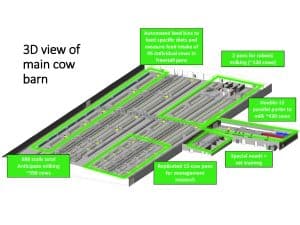
The MSU dairy currently milks 220 dairy cows and supports the research of faculty in the colleges of Agriculture and Natural Resources and Veterinary Medicine. With the expansion, the new dairy will have the capacity to hold 688 cows. There will be 32 tie stalls and around 550 milking cows. According to the timeline, the aim is to have cows producing milk in the new facility by the end of 2025. The main cow barn features a double twelve parallel parlor, two robotic milkers, twelve-cow pens for management research, and automated feed bins to feed specific diets and measure feed intake of 96 individual cows in freestall pens.

“There is nothing on Earth that you can build once and it’s going to serve you forever,” states Dr. Bradford. “We provide a lot of solutions within reproduction and genetics, nutrition, etc. and if we don’

t reinvest in the facility that lets us do that research, it disappears. Now we can continue and grow in those areas of strength research-wise to answer questions about the best way to do things in those spaces.”

The capacity for expansion creates opportunities for greater learning and research opportunities. More than doubling the herd size not only accommodates more research projects but also introduces new technology for enhanced data collection accuracy. MSU has never before utilized replicated pens to observe animal groups, despite many instances where it can be beneficial to study a group opposed to individual cows. Another exciting feature is the automated feed bins that give researchers the ease to precisely evaluate the cow’s feed intake. The two robotic milkers are another key area of research and learning opportunity where students can study the variations between a free flow or managed flow system. There is also additional space near the parlor for veterinary students to practice surgeries and cattle evaluations.

“The dairy industry has advanced well beyond the center’s current capacity, particularly in regard to research potential and teaching modern production practices,” said Doug Freeman, interim dean of the College of Veterinary Medicine. “As we train the next generation of veterinarians, the center will allow them to develop significantly enhanced skills in dairy production medicine, which will enable them to serve clients and better protect local and global food systems.”

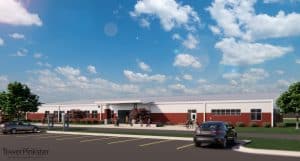
The visitor center boasts expansive glass windows, providing an up-close view of cows in the parallel parlor. Additionally, the main building includes classrooms for 80 students, a conference room, laboratory spaces, work areas for graduate students, staff offices, and locker rooms. The dairy plans to offer public tours for observing its operations. Some parts of the old facility, such as the feed storage area, the digester, and one of the cow barns, will continue to be utilized.

“This cutting-edge facility isn’t just modern,” Dr. Conner said. “It’s a testament to how we can commit to aligning our teaching programs and our research programs with the industries that we are seeking to serve.”

The University hopes to attract the attention of students with an interest in dairy to the brand new facilities and expansive learning center. “Having a nice, safe facility for students to work in will hopefully draw talented people who have an interest in dairy,” Dr. Bradford said. “This will have a direct impact on Michigan’s dairy industry as most producers recognize that if we’re only hiring people that grew up on dairy farms, we will be short of employees. We have to find ways to make this an attractive career path for people that are not from farms.”

Not only will the new dairy impact the industry by recruiting more talent into the field, but it will also be a facility unlike anything in the country. “I like to focus on holistic sustainability. People hear sustainability and, instantly think of environmental impacts, and that’s a part of it. But with this new facility, we can build a strong program around finding the best ways to minimize environmental footprint of dairy production while doing it in a profitable manner, and in a way that lets us get along with our neighbors. The design of our new research facility allows us to do all of that, making it one of the few places in the world that will have it all together in one place,” explains Dr. Bradford.

This project wouldn’t have happened without the support of many partners. MMPA played a role in supporting the building of the new dairy. Dr. Bradford shared, “The reason the Michigan legislature supported this is because MMPA and over 50 other agriculture organizations collectively got behind the need for a new dairy.”

With support from partners like MMPA, MSU is able to continue to share their vision for excellence in sustainability and the circular agricultural economy.

“This new dairy facility will stand as a testament to the power of partnerships,” said Kelly Millenbah, dean of the College of Agriculture and Natural Resources. “These spaces for research, education and outreach will serve Michigan’s farmers and develop tomorrow’s workforce, and we’re so grateful for this investment in the future of agriculture at Michigan State.”

This article was originally published in the May/June 2024 issue of the Milk Messenger. Subscribe »

MMPA members recently elected Paul Keener to serve a three-year term on the MMPA board of directors as a District 1 Director. Keener joins the 12 other dairy farmers on the MMPA board of directors, helping guide the direction of the cooperative and setting strategic goals.

Rosedale Farms LLC, established in 2012 in Ashland, Ohio, has been operational for over a decade. Paul, together with his wife Shyann and their three children, manage 607 acres of farmland and 650 milking cows on their dairy. He became an active member in MMPA when Superior Dairy was acquired in 2021 and is looking forward to providing his insights on the board of directors.

How has MMPA impacted your farm?

MMPA impacts my farm with the quality bonus that they offer. It gives me an incentive to work hard to achieve better milk quality. Although we still have room for improvement, it has changed what we’ve been focusing on to achieve quality milk. After visiting the Superior Dairy plant as part of MMPA’s CORE program, I’ve seen first-hand how our quality milk gets processed and its significance. It brought home the fact that we need to do our part on the farm to produce quality milk.

What do you value most about MMPA?

It’s a farmer owned co-op that provides a secure, competitive marketplace.

Why did you want to join the board of directors?

It’s an honor to be on the board. I want to be on the board of directors to help continue the growth of MMPA. It’s an exciting co-op and is going to continue to grow and evolve. I will do my best to be a voice for the members while on the board.

What are your goals and vision while serving on the board of directors?

To continue to be a strong co-op for the members, as well as continually growing and improving in a responsible manner to best serve its members.

What would you tell members looking to become more active within the cooperative?

It’s your co-op, be active and let your voice be heard. Decisions will be made whether or not you participate, so it’s important to remain actively involved.

This article was originally published in the May/June 2024 issue of the Milk Messenger. Subscribe »