
MMPA is committed to cooperative social responsibility and sustainable business practices throughout our entire supply chain. At the farm level, MMPA members are also on a sustainability journey. We’re checking in with a handful of member farmers leading the charge with this sustainability spotlight series.
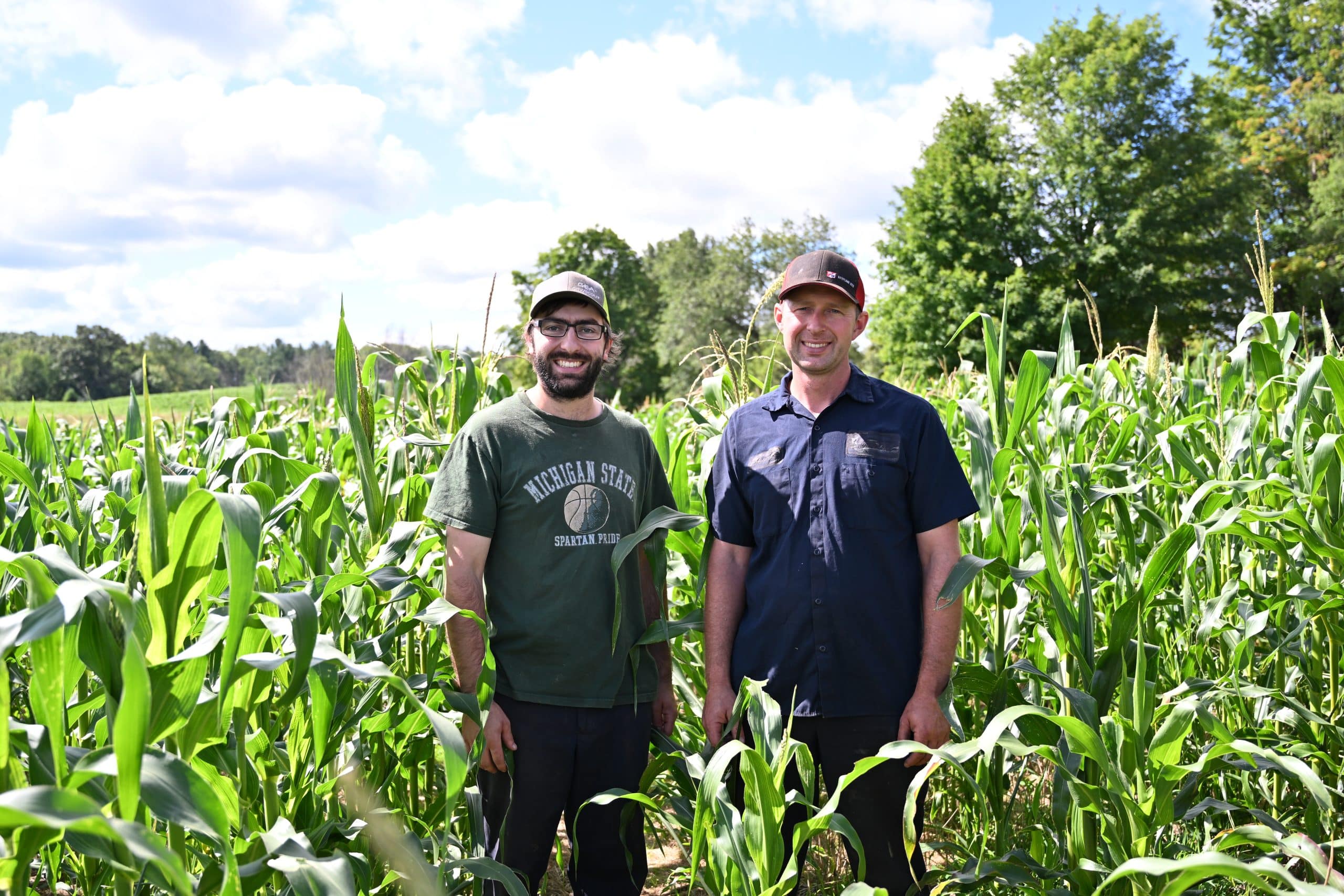
Eric Martin and Brandon Gingrich
When we talk about farm sustainability, we often overlook the most crucial element—the sustainability of the farmer’s own well-being. On Gingrich Meadows Dairy, in Leroy, Mich., they are continuously looking ahead and trying new things to not only make their farm more sustainable, but their quality of life better.
Brothers Eric Martin and Brandon Gingrich are on the same page when it comes to their definition of sustainability. “Sustainability is maintaining practices that allow you to continue operating your business with no end date. That’s for the animals, the land and quality of life,” stated Brandon. Eric added, “You also have to practice things that work for you. You need to sustain your land, because if it’s not profitable or your cows aren’t profitable, you’re not going to have a great quality of life. Happy cows make milk, so you have to keep the cows happy.”
The farm has made it a priority to reduce the amount of labor needed for it to operate. In 2012, eight robots milked 450 cows, but not in an efficient manner, so in 2016 two 16-stall parlors replaced them. Fast forward to February of 2024 and the farm replaced the 16-stall parlors with eight robots.
“The 16-stall parlor didn’t work for us,” stated Brandon.
“We couldn’t keep employees in the parlor and the parlor was starting to be unreliable,” added Eric. “With robots there is a higher level of job satisfaction. With more content employees, the cows are happier.”
There is also a level of consistency with robots that Gingrich Meadows appreciates.
“There is consistency every single time with the robots,” Brandon said. Eric added, “We’re not getting different prep and lag times or different teat dip rates. There is no challenge with teaching employees the importance of proper prep procedure. Cows also go undisturbed most of the day and they’re not being pushed into a hot holding area.”
The implementation of activity monitoring collars in 2012 has also saved the farm a great deal of labor.
Eric described, “Our heat detection system helps us breed off of more natural heats. We’re not synching up cows all the time and giving as many shots, which is also labor intensive and expensive. We have also noticed since the robots have been installed that our heat detection has increased.”
Gingrich Meadows cares a lot about the welfare of their cows and has made great efforts to produce quality forages that benefit the animals’ gut health.
“For five years now, we have been trialing alternative forages to replace alfalfa. We spend four weeks out of the year chopping and putting up alfalfa, so to improve our quality of life and the digestibility of the forage, we explored alternatives.”
Alternative forages have been effective in improving the farm’s time management and animal welfare, while also allowing the added benefit of double cropping.
“Mastergraze is a tillering corn with many shoots that acts like corn when you plant it, but feeds like sorghum. We have fed it for three years now and it has increased digestibility by 25-30% compared to alfalfa. We have also had success with a male sterile forage BMR sorghum Sudan grass. One of the reasons we like the alternative forages is that it treats the cow’s gut better. We do get less pounds of milk in the bank, but we don’t burn them out and we maintain elevated butterfat and protein levels,” Brandon explained.
Although the alternative forages are annual crops, the farm spends less time in the field and are able to harvest a second crop.
Brandon stated, “You can double crop with it so we’re actually getting more tons per acre than alfalfa. Our goal is to always have a living plant in the soil to tie up the carbon, which is how we’re using cover crops- to help build the soil and to feed the next crop.”
The farm has also experimented with biologicals that have significantly reduced their need to add nitrogen and urea to their fields.
“We’ve done some test strips with biologicals, and we’ve gained nitrogen in our fields right out of the program. It’s allowed us to reduce the need of urea fertilizer,” stated Brandon. “Resources on Earth will not be here forever, you’ve got to find ways to be sustainable and biologicals are something we utilize to be sustainable.”
For many generations Gingrich Meadows have been on the forefront of trying new things and being progressive. Brandon and Eric agree, “That’s part of sustainability, you have to do what works best for you. Just because that’s the way it’s been done for the last 60 years doesn’t mean that’s how it has to be done today.”
Biologicals: Crop protection and seed treatment products derived from living organisms, natural materials, or naturally occurring processes. They are used in agriculture to improve the health of food crops and protect them from pests, diseases, and weeds.
Forage sorghum: A type of sorghum that’s been bred for forage production and is often used as an annual hay or forage crop. It can be used as a cover crop to prevent soil erosion and improve soil fertility.
SOURCE: U.S. Department of Agriculture
FARM
Gingrich Meadows Dairy
Leroy, Michigan
HERD
450 milking cows
LAND
1,500 acres of corn, alfalfa, rye, and forage sorghum

VERIFICATIONS
MMPA sustainability survey, FARM* Animal Care and FARM* Environmental Stewardship evaluations, Comprehensive Nutrient Management Plan, and Michigan Agriculture Environmental Assurance Program verified.
This article was originally published in the September/October 2024 issue of the Milk Messenger. Subscribe »