

Michigan State University (MSU) researchers have been studying tar spot in corn fields since its first appearance in Michigan in 2016.
Tar spot is a corn leaf disease capable of causing severe damage to infected crops. Dr. Martin Chilvers and graduate student Peyton Phillips at MSU have been diligently researching this fungal disease and educating producers on effective management strategies.
“We had severe epidemics in 2018 and 2021,” stated Dr. Chilvers. “The fungus thrives in cool, wet conditions. Disease modeling work with colleagues at UW-Madison has resulted in an improved understanding of the conditions and the development of the Tarspotter app which is a decision support system, that helps to predict conditions favorable for disease development.”
Frequent moisture events and increased awareness have led to early detections of tar spot across the region, including Michigan, in the 2024 season. While warm July conditions slowed its progress, tar spot is now easier to find into August and September, with disease pressure increasing in some fields. Weather conditions for the rest of the season are going to be key to its development.
Identifying tar spot
Tar spot is caused by the fungal pathogen Phyllachora maydis. P. maydis and can only infect green corn tissue. The fungus survives on infected corn residue through the winter and releases spores in the spring
that can infect new plants. It is not seed transmitted, though can be moved on infected leaf tissue.
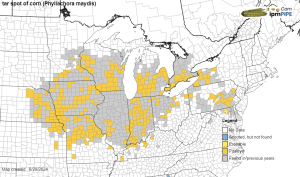
“We map tar spot every year and from this work we can see it’s travelling 10’s of miles per season, including moving into states where it has not previously been reported. It produces many spores that become airborne and are carried by the wind,” explained Dr. Chilvers.
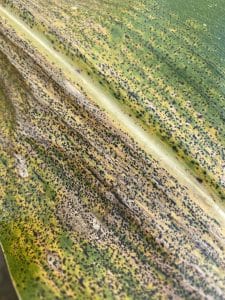
It is reasonably simple to identify tar spot as the lesions are relatively distinct, consisting of a matte black raised spot that is embedded within the leaf and will not rub off the leaf surface. Tar spot thrives in cooler, wet weather conditions, so it is important to be scouting fields during these conditions.
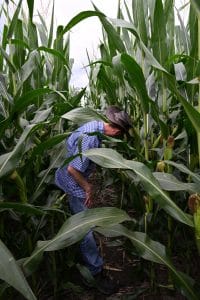
“It is very important to be checking your fields, especially when weather conditions are favorable for the fungus,” stated Dr. Chilvers. “Fungicide cannot be applied as a preventative measure, and once a field is infected the disease can spread quickly.”
Bug feces, scientifically called insect frass, are often confused with tar spot, however these are easy to distinguish as frass will dissolve and wipe off the leaf with some water, while tar spot will not.
“If farmers are unsure whether tar spot is present in their fields, they can send a sample into the MSU Plant and Pest Diagnostic Services,” Dr. Chilvers stated. “Occasionally other diseases are confused for tar spot, we’ve even had fields unnecessarily sprayed when bug poop has been mistaken for tar spot, so be sure of your diagnosis.”
It is important to identify tar spot as early as possible as it can result in rapid dry down of the plant and result in decreased nutritional content compared to a healthy disease-free plant.
“The disease can rapidly dry down the corn plant and result in lost starch,” Peyton explained. “With the rapid dry down yields are reduced and the lignin increases as the starch content is reduced.”
Tar spot is not known to produce any mycotoxins or cause harm to ruminant animals during digestion. However, under high disease pressure, tar spot can overwhelm plant defense responses leading to the rapid dry down of the crop, resulting in lower yields and a reduced nutritional content.
Managing Tar Spot
Use of hybrids with tolerance/resistance to disease is the cornerstone of disease management. A hybrid with partial resistance to tar spot will greatly help slow disease development and has the potential to negate the need for a fungicide.
“Unfortunately, no hybrid is immune to tar spot, but there is significant variation in hybrid susceptibility”, stated Dr. Chilvers. “If you want to minimize damage from tar spot it is very important to select a corn hybrid with tar spot resistance.”
It is not recommended to use tillage as a preventative management practice. Although tar spot does survive on residue, the spores can travel many miles in the wind, negating any benefit from tillage.
Dr. Chilvers explained, “In the severe tar spot epidemic years of 2018 and 2021 there were numerous fields that hadn’t been in corn for years that were severely impacted by tar spot.”
Any value in tilling fields will be short lived as spores blow in from outside fields. Crop rotation is an important tool for disease and insect management, however, variety susceptibility and weather conditions play a much larger role in disease development.
“If you practice crop rotation it doesn’t mean you’re going to escape tar spot because it can blow in from outside,” stated Dr. Chilvers.
Tar spot can rapidly dry down the plant to the point where it can no longer be harvested or is missing vital nutritional content. When considering harvest timing it is important to scout fields to know the severity of the disease during a given growing season. Always remember to check pre-harvest intervals after making a fungicide application as most fungicides need to be applied 30 days before silage harvest.
Fungicide Application
Depending on the timing of disease onset and weather, a fungicide application somewhere from VT/R1 (tassel and silking) through to R3 (milk) is typically the best timing. Early vegetative applications tend to have little effect on suppressing tar spot epidemics and later timings might interfere with harvest if the pre-harvest interval is too long. Applying fungicides at the VT/ R1 growth stage is also ideal for mycotoxin suppression in silage, however, could possibly be too early for optimum tar spot control depending on the year and disease pressure.
MSU continues efforts to develop data sets to train and test the tar spot disease forecasting app “Tarspotter” developed with colleagues at the University of Wisconsin-Madison. The Tarspotter app is free to download and can be found on smartphone app stores (a version is also available via Field Prophet). Tarspotter can be used to assess tar spot disease risk based on weather variables for multiple pinned locations within the app. When using the app keep in mind that is still important to scout fields to see if disease is present and be mindful of crop growth stage. Funding for this work was also made possible by the Corn Marketing Program of Michigan and the National Predictive Modeling Tool Initiative through the USDA.
Dr. Chilver warns, “Although we have seen greater disease suppression with two fungicide applications, this is not always profitable. In fact, some years a fungicide may not be needed. In general, we recommend the use of a fungicide product with mixed modes of action, this typically provides better disease suppression than a single mode of action product.”
Dr. Chilvers and his team are also weary of the development of fungicide resistance in the tar spot fungus. By using a mixed mode of action fungicide, it should slow the development of fungicide resistance.
“Each year we conduct fungicide efficacy trials to assess current and new products and combinations,” Peyton described. “We have tested various fungicide products and there are a couple that do perform a little bit better, but really it comes down to application timing. That’s the more important factor.”
If you do decide to make a fungicide application, be sure to leave check strips and pencil out the costs and benefits, otherwise you will never know what your return on investment is.
The Michigan Alliance for Animal Agriculture (MAAA) is a partnership among the state’s animal agriculture industries and MSU focused on advancing the Michigan animal agriculture economy. MAAA’s partnership with MSU allows scientists such as Dr. Chilvers and his team to continue researching relevant crop diseases in Michigan.
“Sample analysis testing can be very expensive, so without the help of MAAA none of this would be possible,” said Dr. Chilvers. “We’ve generated an awful lot of data through analysis testing, which has been really cool. Now we’re just working through getting it organized and analyzing it for publication to share with the growers.”
MMPA is proud to partner with MAAA to support research, extension and seed grant projects that will enhance Michigan animal agriculture.
This article was originally published in the September/October 2024 issue of the Milk Messenger. Subscribe »