
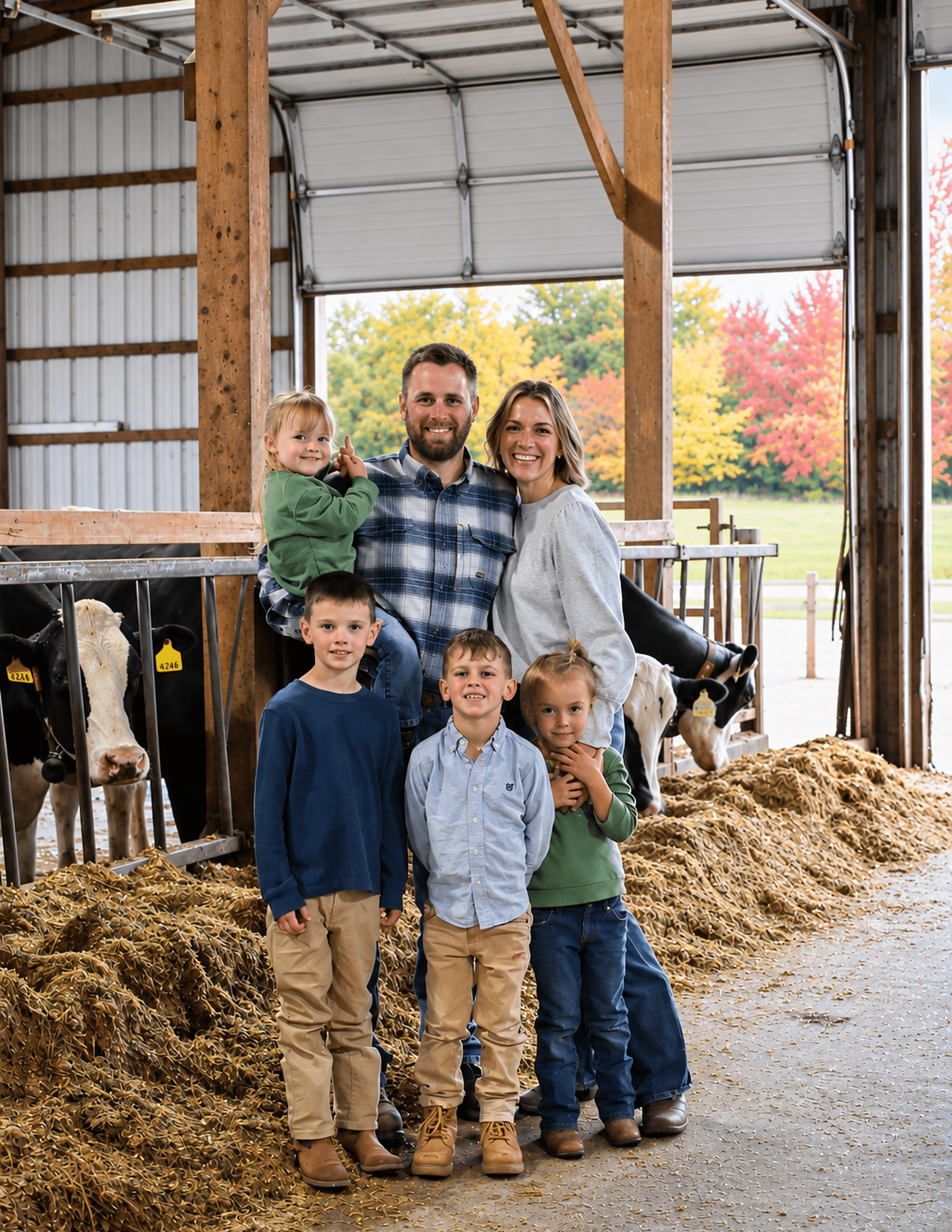
Dairy farming is rarely just about the cows. It is about the decisions made before sunrise, the people who keep the operation running and the responsibility of building something that will last. For Bryan and Molly Benson, that responsibility carries more than 150 years of family history, dating back to when Bryan’s great-great-grandparents homesteaded the original 80 acres in 1870.
“I think we’ve come a long way in the last 10 years, and we’ve got a long ways to go,” Bryan said.
That outlook shapes how the Bensons approach their operation. They are proud of what they have built, but they know there is always room to improve. From robotic milking to employee management, their focus remains on making the farm sustainable for the next generation.
Finding His Place
The Benson family farm has grown through several generations of change. Bryan’s grandfather took over the operation at just 16 years old after his father died, eventually growing the herd from approximately 35 cows to 70. Bryan’s parents took over in 1985 and built a new freestall barn and milking parlor in 1990, expanding to approximately 140 cows. Bryan’s path back to the farm was not always certain.
“I thought my brother would do it when I was in high school,” he said. “I wanted to go into construction.”
When his brother pursued a career in construction, Bryan returned to the farm full time. Over time, he assumed more responsibility, and in 2017, the family began planning a major transition to robotic milking. The new barn opened in 2018, marking a new chapter for the dairy.
“The first year that we were in the robots was a lot of training with cows,” Bryan said. “I just spent a lot of time in the barn.”
The transition also meant a shift in responsibilities between Bryan and his father. Bryan took the lead on the dairy while his father focused more on crop production. As the years passed, Bryan gradually took on more of the crop work, too.
Like many family businesses, the transition required patience and an evolving understanding of who would manage each part of the operation. New equipment and changing responsibilities helped move the process forward. Bryan’s work now spans much of the farm’s daily operation, from maintaining the robots to managing feed and inventory.
“I do all the robot maintenance,” he said. “Scheduling, feed ordering, inventory, and I enjoy all of it.”
The farm now includes approximately 900 acres of corn, 500 acres of alfalfa and another 200 to 300 acres of grass hay.
Managing People and Expectations
Technology has changed how the Bensons milk cows, but it has not eliminated one of their biggest challenges: finding and retaining employees.
“Labor has been the biggest challenge,” Bryan stated.
Molly helps with bookkeeping and fills in wherever she can.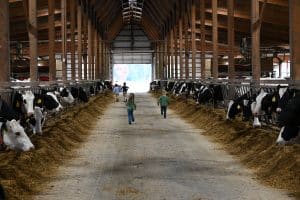
“If the guys aren’t here to fetch, I get to go out and do it,” she said.
Building a reliable team has taught the Bensons that management requires flexibility. Schedules and written procedures provide structure, but responsibilities sometimes need to change to match employees’ strengths.
“We’d like to delegate so that we aren’t doing everything, but we find that you have to work with people’s strengths,” Molly said.
Training is another important part of the process.
“You have to go to the basics quickly,” Molly said. “We need ‘this’ to be clean. We need it to be thorough. We need to be consistent.”
Those fundamentals establish the foundation for more specialized responsibilities, from animal care to routine herd health practices. When employees leave, however, the process can start over. The couple continues to refine how they train employees, communicate expectations and build a team that can thrive.
“We’re not perfect bosses, but we work hard to provide wages that make it worthwhile for our employees,” Molly said. “That means being thoughtful about how we hire, how many people we bring on and how much we can grow while still being able to afford the team we have.”
Their goal is to build a farm that supports both the people who work there and the family that owns it. That means carefully considering how much the operation can grow while maintaining the standards they believe are important.
Making Sustainability Practical
Sustainability is an ongoing effort on the Benson farm, from crop production to cow comfort and energy efficiency.
“We’ve done cover crops for years,” Bryan said. “I don’t remember when we haven’t done cover crops.”
When the family built its robotic barn, it also looked for ways to improve efficiency and create a comfortable environment for the cows.
“It’s all LED lights, all the fans are on temperature controls, the curtains are all temperature control,” Bryan said.
The goal is to make the barn work for both the animals and the people caring for them.
“Trying to create an environment for the cattle that’s healthy for them and easy for us to work in,” he said.
The Bensons continue to consider changes to the barn’s layout and cow movement, including a guided-flow system that could help address certain herd health challenges. They have also started incorporating GPS technology into crop production. The transition to new technology takes time, and Molly has a lighthearted way of describing their progress.
“We’re still like the 1999 farmers, you know,” she jokes. “We’re advancing, but only to 1999, I feel like.”
Managing financial uncertainty is part of the job, too.
We utilize Dairy Revenue Protection and Dairy Margin Coverage to help manage market risk, he stated.
Every investment, whether it involves equipment, facility improvements or future expansion, must be weighed against what the business can sustain.
Learning Through the Cooperative
MMPA is an important part of the Bensons’ long-term vision for the farm. Bryan sees the cooperative as a source of market stability and a connection to the broader dairy industry.
“I believe that co-ops play a really big part in being able to have a stable market for our milk,” he said. “I think MMPA has done a really good job at that.”
Their involvement in MMPA’s Outstanding Young Dairy Cooperator program provides another opportunity to learn, connect with fellow
producers and become more engaged in the cooperative.
“Learning is probably the biggest reason we decided to apply for the OYDC program,” Bryan said when asked why they decided to participate.
He enjoys learning more about the industry and exploring ways to improve it. The program gives the couple opportunities to hear from other farmers, exchange ideas and bring new perspectives home to their own operation.
“Some of the people who would be the veterans within MMPA that we’ve gotten to sit with at MMPA district meetings have been really inspiring,” she said.
After years of raising young children and helping manage the farm, Molly appreciates having an outlet that allows her to connect with others and pursue her interest in communication.
“Being able to take your world and use giftings that are enjoyable to me, like talking to people and networking with people, traveling, all of those things were kind of fitting in with this,” she said.
She also sees the program as an opportunity to highlight Bryan’s work and help others understand what it takes to operate a dairy farm.
“We like to talk about dairy,” she said.
Building the Next Generation
The Bensons’ vision extends beyond the next investment or expansion. They want to build a farm their children can understand, appreciate and potentially carry forward.
“I can’t wait until my kids are old enough that they can do it,” he said.
He hopes to coach them as they learn, while also imagining a future when he can step back from some of the daily responsibilities.
“I want to coach them,” Bryan said, “but I also want to sit on my deck and drink coffee.”
For now, the family’s goals are practical: improve milk quality, continue working on production and genetics, pay down debt and be good stewards of what they have built.
“I’d say our biggest goal is to pay off some debt and be good stewards of what we have,” Bryan said.
Molly hopes their children will grow up respecting the land, treating animals well and understanding the importance of agriculture.
“We would like our children to be people who love the land and respect the cows”, she said.
She wants them to recognize that farming is about more than the family’s livelihood. It is also about providing what people need and ensuring agriculture remains part of the country’s future.
“People don’t realize how important this industry is,” Molly said. “They don’t see that it is really what is going to help keep us going as a culture.”
The Bensons know that keeping the farm in the family will require hard work, careful decisions and a willingness to adapt. Their operation looks vastly different from the original 80 acres homesteaded in 1870, but their commitment to caring for the land and preparing the next generation remains.
This article was originally published in the November/December 2026 issue of the Milk Messenger. Subscribe »