
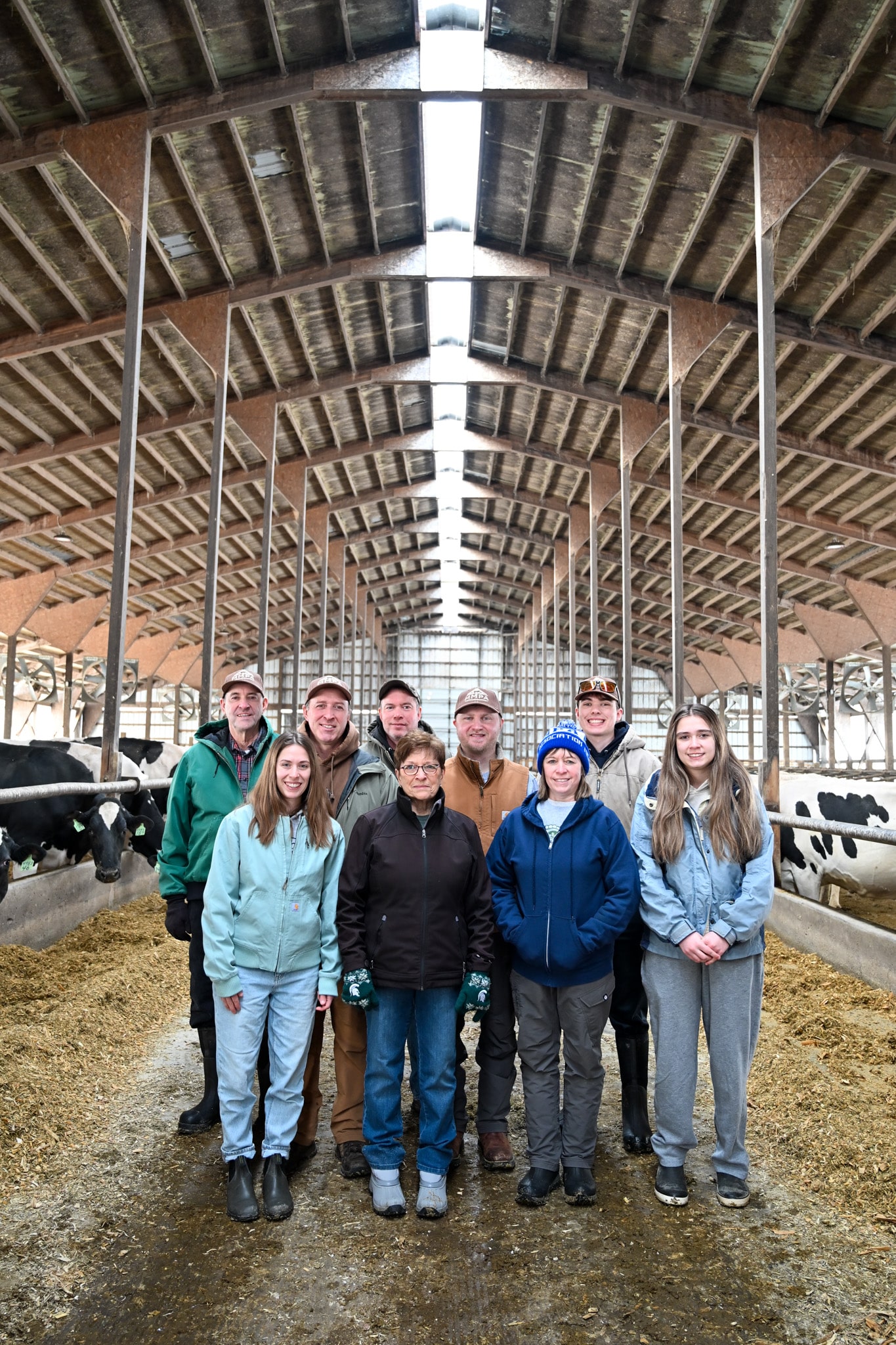

At Hardy Spring Lake Farms, high quality milk isn’t an accident. It’s not luck, either, though they’ll humbly tell you there’s always a little bit of that involved.
“You can work your tail off all year,” Bill Hardy said with a grin, “and if they pull a milk sample on the one day you messed something up, that’s the day that gets you.”
Quality here is built in the quiet moments: in the middle-of-the-night glances at cow cams, in the careful decision to sell a good cow to make room for a better one, in the steady rhythm of milking done the same way, the right way, every single day.
That commitment is what earned the Hardy family MMPA’s 2025 Top Quality Award, finishing the year with an impressive somatic cell count of 44,910. It’s a number that speaks volumes about their management, consistency and attention to detail leading to producing high quality milk. This year’s recognition is well deserved, and it adds to a history of excellence rather than beginning one. The Hardys also earned Top Quality honors in 1993 and 1999, a testament to a standard that spans generations.
Hardy Spring Lake Farms, located in Stanton, Mich., has been in the Hardy family since 1914. What began with 15 cows under Mike Hardy’s father has grown, gradually and intentionally, into a 200-cow Holstein herd now owned by brothers Bill and Jason. They’ve been in their current facility since 2005, after building across the road from their original farmstead.
“My dad started with about 15 cows,” Mike shared. “We were milking 100 across the road for years. We didn’t go out and buy another hundred cows when we built this place. We grew into it.”
While the facilities and numbers are impressive, what truly sets this operation apart is the people behind it.
Three families are actively involved in the day-to-day operation of the dairy. Mike and Judy, children Amy, Bill and Jason and grandchildren growing up in the barn aisles. It’s rare to see that many hands-on family members working together so seamlessly, and even rarer to see it done with such unity and purpose.
“It’s a tremendous blessing to have a family that’s together,” Mike shared. “It’s not a sprint, it’s a marathon.” A phrase that defines not just their approach to farming, but to family as well.
Built by Their Own Hands
Drive through Hardy Spring Lake Farms and you’ll see more than barns, you’ll see fingerprints.
“There isn’t a barn on the property that we didn’t have a hand in building,” Bill said.
From the main freestall barn to the calf facility, the Hardys were there, pouring cement, setting trusses, wiring cameras and finishing details.
“I spent most of one summer building the calf barn by myself,” Bill recalled. “Just me, a hammer and a manlift.”
Mike added with a laugh, “If I hadn’t farmed, I probably would’ve been a carpenter.”
That mechanical mindset carries over into their dairy management. Bill, who originally studied packaging at Michigan State University, now serves primarily as herd manager.
“I like engineering things, building things, figuring things out,” he said. “Cattle’s almost my side job sometimes, but I like doing that too.”
Jason focuses heavily on crops, feed and nutrition.
“He’s basically the nutritionist,” Bill explained.
Mike nodded. “He’s in charge of making sure we’ve got enough feed to feed the cattle.”
With approximately 800 acres of corn, soybeans and alfalfa, the farm raises as much of its own feed as possible. It’s part of their commitment to staying within their means.
“Even from the equipment side or the land side, we try to stay within our means,” Bill said. “You don’t go out and borrow money just because you think you need something.”
Amy, who returned to the farm in 2022, plays a critical role as well. Her attention to detail has become part of the farm’s culture. Mike credits her for their earlier quality awards. She watches the small things; the protocol, the consistency and the follow-through.
And then there are the next-generation family members, helping milk mornings and afternoons, feeding calves, stepping in during summer fieldwork. Even those with off-farm careers remain deeply connected to the daily operation.
It works because everyone understands their role and respects each other’s strengths.
Consistency Is King
When asked what contributes most to achieving such a low somatic cell count, the answer wasn’t flashy technology or revolutionary change.
“Being consistent,” Bill said simply.
“You’ve got to do everything right,” Amy added.
The Hardys milk in a double-10 parlor, focusing heavily on proper protocol.
“You can’t just dip and wipe and throw the unit on in 15 seconds,” Bill explained. “You have to follow the proper protocol.”
A recent investment in new takeoff sensors has also paid dividends.
“Over-milking cattle gets you in trouble more than anything,” Mike said. “If you have equipment that gets the units off on time, it really helps cow comfort and milk quality.”
It’s a subtle improvement, but one that aligns perfectly with their philosophy of managing the details.
They also maintain a closed herd, raising all of their own replacements.
“We haven’t bought cattle here since 1972,” Mike shared.
That level of control provides consistency in health, genetics and performance. With over 100 heifers freshening annually, they have the flexibility to be selective, and they are. If a cow doesn’t fit the long-term vision of the herd, she moves on, often into the dairy market, where strong animals still hold value.
“We’re at a point where they’re all good cows,” Judy said. “Sometimes it’s hard to decide.”
Stall management also plays a critical role in their quality success.
“We’ve bedded with sand forever,” Bill said.
Fresh sand is added as needed, not by calendar, but by observation.
“It’s not a once-a-week thing,” Bill explained. “If a stall looks low, we add sand.”
He once believed he could control the tank’s somatic cell count simply by managing stalls well.
“And honestly, it’s part of it,” Mike affirmed. “How clean you keep those cows makes a huge difference.”
Granddaughter Tina, who spends a lot of time in the parlor, has noticed the difference over time.
“I used to wipe a lot more sand off udders,” she said. “Now there’s hardly any there. They’re just cleaner.”
When cows enter the parlor clean, the rest of the process becomes smoother and more consistent.
“They come in clean,” Mike said. “You wipe them and there’s nothing there. That’s because the stalls are clean all the time.”
Another quiet contributor to their success? Cameras.
Long before “cow cams” became commonplace, Bill was experimenting with different systems, wiring setups and monitoring tools. Today, the maternity pen is wired directly into Mike’s home monitor. He keeps watch overnight, stepping in only when needed.
“It saves a lot of trips to the barn,” Mike said.
Amy also checks from her phone. Between experience and vigilance, the farm has dramatically reduced calf losses. In today’s market, when newborn calves carry significant value, that attention pays off, financially and ethically.
But beyond dollars, it reflects something deeper: stewardship.
The Hardys don’t just manage cows. They watch them. They know them. They anticipate problems before they escalate. It’s a mindset built over decades.


A Lifestyle and a Legacy
Dairy farming isn’t for everyone. Twice-a-day milking, every day. Weather extremes. Market swings.
“But it’s a lifestyle,” Mike said. “I don’t regret any of it. I’ve been totally blessed to raise a family here.”
That gratitude echoes through each conversation. They understand that the ability to farm together, across three families, is rare. It requires patience, humility and a shared commitment to something bigger than individual preference.
It also requires trust.
Bill delegates. Amy observes. Jason plans ahead. Mike mentors and monitors. The younger generation steps in and learns by doing. There is teasing and laughter in the barn, but also accountability.
When they won Top Quality in 1993 and 1999, they were operating in different facilities, with different equipment and fewer cows. The fact that they’ve achieved it again in 2025, two decades later, in a larger and more complex operation, may be even more meaningful.
The tools have changed. The scale has changed. The standard has not.

This article was originally published in the March/April 2026 issue of the Milk Messenger. Subscribe »