
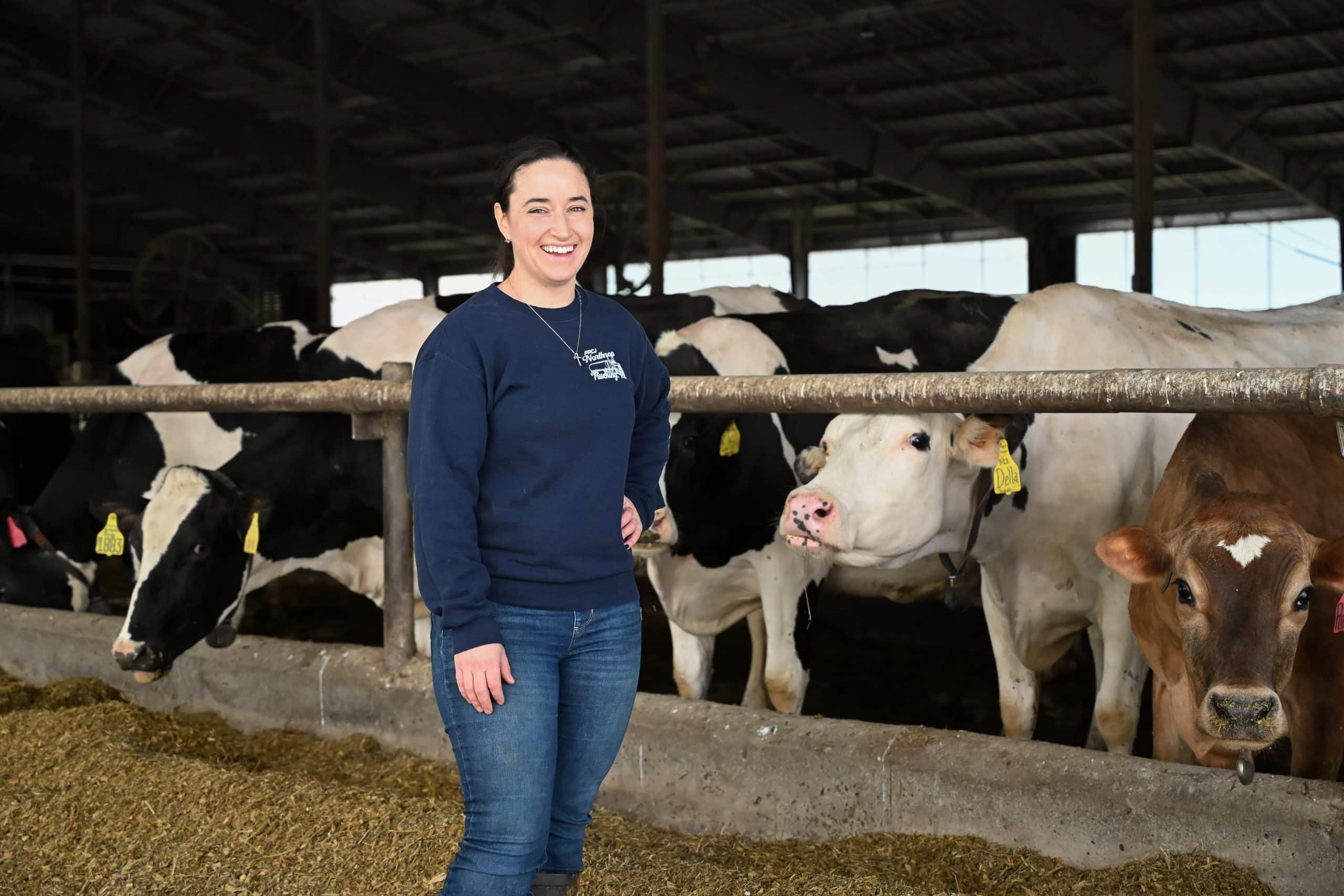
MMPA is committed to cooperative social responsibility and sustainable business practices throughout our entire supply chain. At the farm level, MMPA members are also on a sustainability journey. In recognition of the United Nations’ designation of 2026 as the International Year of the Woman Farmer, this year’s sustainability spotlight series checks in with a handful of our female member farmers who are leading the charge.
On a family dairy farm built from the ground up in the 1970s, sustainability is a daily practice shaped by decades of decisions, challenges and careful attention to detail. For Rosemary Sample, who co-owns and operates Rose Valley Dairy LLC, in Filion, Mich., alongside her brother Val, sustainability is rooted in a simple but powerful idea: building a business that lasts.
“Our definition of sustainability really comes down to creating something that will stand the test of time,” Rosemary explains. “It’s about efficiencies and knowledge, understanding what you’re doing well, where you can improve and making sure everything works together long term.”
That mindset has guided the siblings since they officially took over the operation in 2011, following a trial period encouraged by their father. Unlike many farm transitions, the handoff came with few safety nets.
“It was very much, ‘If you’re going to buy it, you’re on your own,’” Rosemary recalls.
That early independence forced them to learn quickly, make decisions confidently and take full ownership of the farm’s direction.
Even before purchasing the farm, Rosemary was already seeking out ways to improve it. As a young farmer, just 19 years old, she began exploring conservation programs through the Natural Resources Conservation Service (NRCS), looking for practical ways to strengthen the farm’s infrastructure.
“We weren’t thinking in broad terms at first,” she says. “We focused on what would make the biggest impact right away: manure handling, cover crops, improving how things function day-to-day.”
One of their early investments was a fully concrete manure pit, designed for durability and long-term use. With reinforced thickness and careful consideration of drainage and freeze-thaw cycles, the system reflects the farm’s broader philosophy, invest for long term use to avoid costly issues later. That same attention extends across the operation. From heavy-use concrete areas to nutrient management and cropping strategies, each improvement is evaluated not just for immediate return, but for how it contributes to overall efficiency.
Today, the farm milks around 250 cows using a combination of robotic milkers and a double-nine parlor, allowing flexibility to manage different animals effectively. Rather than maximizing herd size, Rosemary and her brother focus on optimizing what they already have.
“We’d rather fine-tune our efficiencies before we expand,” she says. “If you’re not doing things efficiently now, for us; growing only makes those problems bigger.”
Rosemary personally handles breeding decisions, selecting bulls heavily based on traits like feet, legs and udder conformation, key factors in longevity and productivity. While genomic testing has become more common across the industry, she relies heavily on proven performance.
“If a cow has shown she can last 12 or 13 years and never miss a beat, that tells you everything you need to know,” she explains.
The result is a herd built for durability, with animals that remain productive well beyond industry averages.
Heifer management also reflects that long-term mindset. During the summer months, heifers are pastured to support hoof health and overall wellness. While pasture ground can be costly and doesn’t always deliver immediate financial return, Rosemary sees it as an investment in the herd’s future. Healthier animals, she notes, lead to fewer problems down the road and stronger performance over time.
In recent years, Rosemary has abruptly expanded her role to include crop management, gaining a deeper understanding of how soil health and feed production tie directly into dairy performance.
“It’s really interesting because working with crops isn’t that different from working with cattle,” she says. “It’s just a different language: understanding inputs, balancing nutrients and figuring out what works best for your farm.”
The farm grows corn, soybeans, wheat and alfalfa, with a strong emphasis on practices that improve soil health and nutrient retention.
Cover crops are planted following manure application to protect soil and maintain living root systems, while filter strips help manage runoff from high-traffic areas. These practices not only support environmental stewardship, but also improve the efficiency of nutrient use across the farm. Rosemary and Val are increasingly interested in exploring soil biology and conducting side-by-side trials to better understand how different approaches impact crop performance. Like their work with cattle, their cropping decisions are guided by observation, data and a willingness to adapt.
“Sustainability really fits into everything you do on the farm,” Rosemary says. “Whether it’s selecting a bull, choosing a crop variety or managing manure, it all plays a role.”
This whole-farm perspective shapes how decisions are made, encouraging continuous evaluation and improvement across every area of the operation.
While large investments and technology play an important role, Rosemary believes some of the most meaningful gains come from small, consistent adjustments. From hoof trimming schedules to feed management and daily observation of cattle, attention to detail is a defining characteristic of the farm’s success.
“Even small changes can have a big impact over time,” she says.
At its core, Sample’s approach to sustainability is grounded in responsibility, to the land, to the animals and to the future of the farm. Every decision, whether large or small, is made with longevity in mind.
“You have to look at everything you’re doing and ask, ‘Is this going to last?’” she says. “If it’s not, then you need to find a better way.”
Filter Strips: A strip or area of herbaceous vegetation, typically located at the lower edge of a field, used to remove contaminants, such as sediment, nutrients, pesticides and organic material, from overland flow.
Genomic Testing: The mapping and sequencing of genetic material (DNA) in an organism, combined with the use of that information to understand the role of genes, how they are controlled, how they work together and how they contribute to specific traits.
SOURCE: U.S. Department of Agriculture
FARM
Rose Valley Dairy LLC
Filion, Michigan
HERD
250 milking cows
LAND
500 acres of corn, soybeans, wheat, and alfalfa

VERIFICATIONS
FARM Animal Care
This article was originally published in the May/June 2026 issue of the Milk Messenger. Subscribe »