
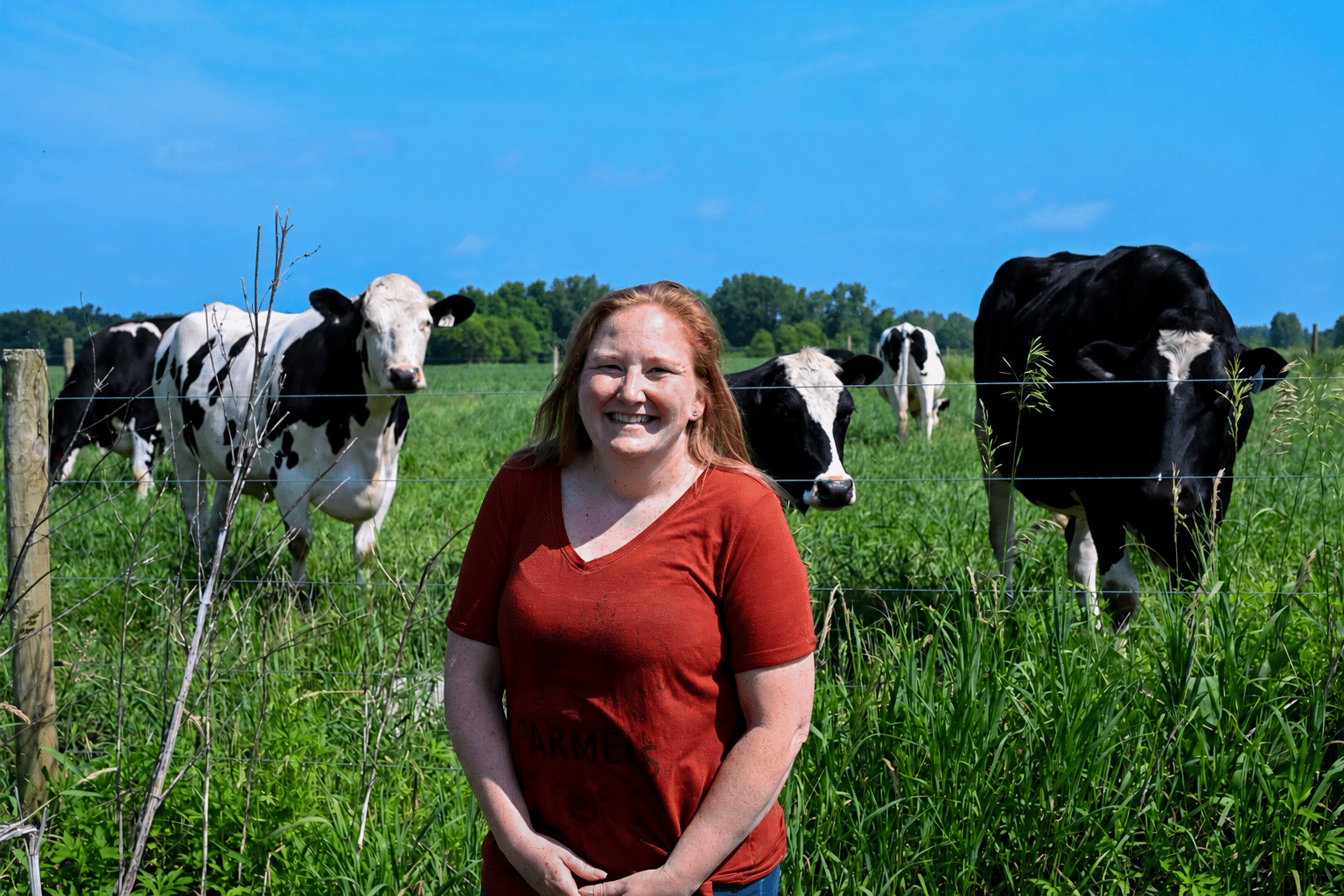
MMPA is committed to cooperative social responsibility and sustainable business practices throughout our entire supply chain. At the farm level, MMPA members are also on a sustainability journey. In recognition of the United Nations’ designation of 2026 as the International Year of the Woman Farmer, this year’s sustainability spotlight series checks in with a handful of our female member farmers who are leading the charge.
“When I hear sustainability, the goal is to keep it around for the next generation and to be able to pass something on,” said MMPA member Molly Andersen. “It’s our job to make it viable for the next generation and to keep it in good shape for the future.”
That philosophy drives nearly every decision Molly makes at McCracken Andersen Farms, where she, her husband Brandon and her father work together to milk approximately 100 cows and farm 1,200 acres.
For Molly, sustainability means much more than environmental stewardship. It means creating a farm business that can withstand challenges, support employees, adapt to changing markets and remain strong enough to continue for generations to come.
The path began when Molly graduated high school and learned her father was considering selling the dairy herd.
“I didn’t want to see it go,” she said. “I wanted to keep it going.”
While many of her classmates were preparing for college loans, Molly had earned a full-ride scholarship to Central Michigan University. Instead of taking on student debt, she made a different investment.
“I took out my first FSA Young Farmer loan to buy cows when I was 18,” Molly said. “Instead of taking out college debt, I took out a cattle loan.”
Like many beginning farmers, the experience came with hard lessons. She experienced health challenges in purchased animals , but Molly remained determined to grow the herd and continue improving the operation.
“That’s why it’s been such a slow growth,” she said. “We learned a lot from it.”
Today, the farm has grown from roughly 50 milking cows when Molly became involved to around 100 milking cows, with plans to continue expanding through home-raised replacements.
As a woman taking over the dairy operation, Molly also faced challenges that had little to do with cows.
“I remember the first salesperson that came in,” she recalled. “The first thing he said to me was, ‘Where’s the man on the farm?'”
At the time, Molly was responsible for managing the dairy herd. She pointed the salesperson toward her father, who promptly directed him right back to her.
“I kind of told you that,” Molly remembered thinking when he returned.
Experiences like that taught her an important lesson.
“You have to prove yourself,” she said. “It is a man’s world. I feel like I grew up in a man’s world.”
Over the years, however, she has seen attitudes change and more women stepping into leadership roles across agriculture.
“I think there’s a huge place for women in the farm world,” Molly said. “There are things we bring to it that men lack, and there are things they bring that we lack. It’s a give and take.”
When asked what advice she would give young women considering a career in dairy farming, her answer was simple.
“Be strong,” she said. “Don’t get intimidated.”
One of the biggest lessons Molly has learned is that long-term sustainability requires diversification.
“If I could give any advice, diversify,” she said.
That belief led Molly and her husband to launch a wedding venue down the road from the farm in 2018. What started as a side business has become an important part of the operation’s financial stability.
“The wedding venue allows us to put all the farm money back into the farm,” Molly said.
Today, the venue hosts weddings nearly every weekend from spring through fall, providing an additional revenue stream that helps offset market volatility and fund future improvements.
The same mindset influences other management decisions on the farm. The Andersens utilize beef-on-dairy breeding, forward contracting and continually evaluate ways to improve efficiency and manage costs.
Environmental stewardship also remains a priority. The farm has implemented cover crops, crop rotation, soil sampling and nutrient management planning to improve soil health and make the most of available resources. A new manure storage facility and manure management improvements are helping position the farm for future success.
“We’re trying to be good stewards of the land and the animals,” Molly said. “I think that’s any farmer’s goal.”
Recent investments have included a new double-10 parlor, expanded calf facilities and additional infrastructure designed to improve animal care and operational efficiency.
“We take pride in taking good care of our cows,” Molly said. “A lot of our cows have names. We know our cows by name.”
Just as important as caring for the animals is caring for the people who help make the farm successful.
“I always wanted to get the farm to a size where we could afford good help,” Molly said.
The farm currently employs two full-time team members and an additional part-time helper. Molly believes investing in employees is essential to the long-term sustainability of any operation.
“We’re very blessed to have them,” she said.
Finding dependable employees can be one of the biggest challenges dairy farmers face, but Molly credits her team for helping keep the operation running smoothly day after day.
“To have people you can rely on and know they’re going to take care of the cows for you, and they love the cows just as much as you, is huge.”
For Molly, sustainability ultimately comes back to preparing the farm for the future.
“It’s hard to see so many small farms selling out,” she said. “You hope that’s not going to be you.”
Through diversification, stewardship, strategic investments and a strong support team, Molly is building a farm she hopes will remain viable for years to come.
“Our job is to make it viable for the next generation,” she said. “And to be able to pass something on.”
Beef-on-Dairy: A production system where dairy cows are bred with genetics from beef breeds (such as Angus or Limousin) to produce crossbred calves that are finished for beef, providing an additional revenue stream for farms.
FSA Young Farmer Loan: A financing program designed for beginning farmers and ranchers who have operated a farm for 10 years or less and do not own farmland exceeding 30% of the average farm size in their county. These loans provide targeted credit opportunities and down payment assistance to help individuals establish or expand their agricultural operations, particularly those who may have limited access to traditional financing or startup capital.
SOURCE: U.S. Department of Agriculture
FARM
McCracken Andersen Farms
Carson City, Michigan
HERD
100 milking cows
LAND
1200 acres of corn, soybeans, wheat, and hay

VERIFICATIONS
FARM Animal Care, FARM Environmental Stewardship
This article was originally published in the July/August 2026 issue of the Milk Messenger. Subscribe »