
MMPA is committed to cooperative social responsibility and sustainable business practices throughout our entire supply chain. At the farm level, MMPA members are also on a sustainability journey. We’re checking in with a handful of member farmers leading the charge with this sustainability spotlight series.
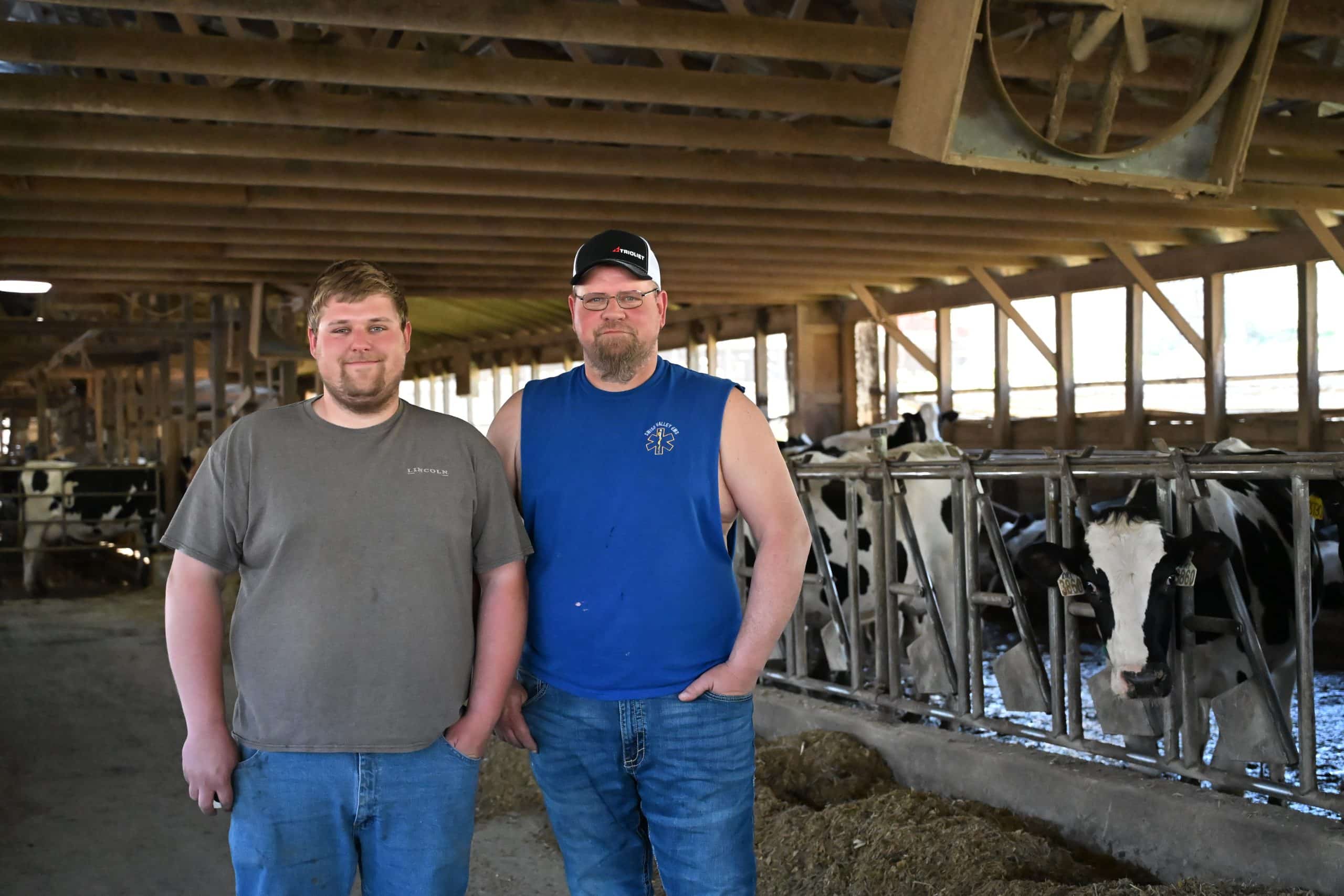
 Pictured Mason and Dean Goedel
The Goedel family is committed to farming for the long haul and they’re making all the right moves to ensure their dairy remains a sustainable, generational business.
Dean Goedel represents the third generation on Goedel Dairy Farm. He works alongside his son, Mason, his brother and two nephews to carry forward the legacy his father built. Soon, a fifth generation might join the team, with Dean jokingly noting that even his two-year-old grandson is “almost ready to start working.”
“Generational is what we are after,” stated Dean. “My son, Mason, and I both decided we wanted to stay on the farm so this January we made the decision to transition ownership from my father.”
Within the rolling hills of Fresno, Ohio, the Goedels milk 420 cows and farm 650 acres of corn, triticale and alfalfa. They’ve found their sweet spot, growing just enough feed to match their herd size. With land prices climbing as high as $18,000 per acre, expanding their acreage isn’t financially viable.
“We’re lucky my father purchased 350 acres about five years ago,” Dean shared. “If he hadn’t, we probably wouldn’t have a chance here.”
Instead of chasing growth, Dean and Mason are focused on maximizing efficiency and making every acre and every cow count.
Dean explains, “Sustainability to us is not about getting bigger and bigger. It’s being the most efficient with what we have and making sure what we have pays.”
Their approach includes several facility improvements that are already paying off. One major change was switching stall bedding from mattresses with sawdust to sand bedding.
“We had mattresses with sawdust bedding in our stalls, but when those needed replaced, we decided to try sand. We tore everything out back down to the cement and then we went with a three-inch pipe across the back and that’ll hold about 5 to 7 inches of sand in the stall,” Dean explained. “It has made a huge difference in our facility. We’ve gained 5 pounds in milk production, breeding is better than ever, somatic cells count, a common milk quality indicator, is the lowest we’ve ever had, and butter, fat and protein are at the highest we’ve ever had.”
Though sand bedding requires more labor, it’s dug out three times a year, the payoff in cow comfort and productivity is clear.
“You can see the night and day difference in the summer,” Dean said. “The cows are just more comfortable. And that’s everything. If they’re not comfortable, they’re not happy and they won’t produce well. What I’m most proud of is how well we take care of our cows.”
Beyond bedding, the Goedels have added sprinklers to the barns and holding pens and plan to install additional fans. They also prioritize low stocking densities, ensuring their dry cow pens never exceed 90% capacity.
Two years ago, they implemented the CowManager system, a move that’s had a big impact.
“Conception rate has risen 10%, heat detection has increased 20%, cows get treated for illness quicker and we are saving money not using tail chalk to detect for heat detection anymore,” said Dean.
Sustainability efforts extend to the fields as well.
Mason notes, “We are doing more soil testing to better know how much fertilizer to apply, and we are using manure as our main fertilizer.”
The Goedel’s are also double cropping, utilizing dry dams and repairing a diversion ditch and planting a variety of native grasses that are pollinator friendly flowers. All of this is in an effort to reduce soil erosion, which is especially necessary for their hilly landscape.
Dean also maintains 25 honeybee colonies across the farm’s woodlands, noting, “We’re not the only living things on this land, there are others we need to live in harmony with.”
The colonies are spread across the Goedels woodland where the trees provide ample amounts of pollen for the bees to produce their honey. The trees that surround the farm also play a role in their sustainability efforts. Dean keeps a catalog of all trees and carefully selects which ones can be logged, treating the woodland as a renewable crop.
“The trees are a crop that we take off the farm and the profits go back into the farm. If managed properly, they can be a generational crop that provides a generational income.”
To ensure financial stability Dean forward contracts both his inputs and his outputs.
“MMPA has a great forward contracting program that I use to lock in at least 20% of our production,” he said. “We also utilize the Dairy Revenue Protection when it makes sense. To lock in all our commodities and inputs we work with a marketing firm out of Wisconsin. I know it costs a little bit of money, but someone that’s good at it will make that money back.”
Whether it’s crop planning, animal care or financial strategy, the Goedels are making smart, forward-thinking decisions to sustain their farm for generations to come.
“Everybody’s always saying that the big guys are eating the small guys up,” Dean said. “But really, it’s the fast ones that are eating the slow ones up. If you’re not keeping up with change, you’re falling behind. Nobody likes change, but it is inevitable so you might as well embrace it and use it to move forward.”
Diversion Ditch: A narrow channel with a supporting ridge on the lower side, constructed across the slope on steeply sloping land. A diversion ditch helps control erosion on steep cropland by diverting runoff to a stable outlet.
Forward Contracting: Forward contracts are those purchases based on the Chicago Mercantile Exchange (CME) and/or other “futures” type pricing mechanisms where the price is available for months in the future and a price can be locked in at any time based on those prices. Forward contracts can also be those transactions where a price is negotiated for delivery for 31 or more days out.
SOURCE: U.S. Department of Agriculture
FARM
Goedel Dairy Farm
Fresno, Ohio
HERD
420 milking cows
LAND
650 acres of corn, triticale and alfalfa

VERIFICATIONS
FARM* Animal Care
This article was originally published in the May/June 2025 issue of the Milk Messenger. Subscribe »