
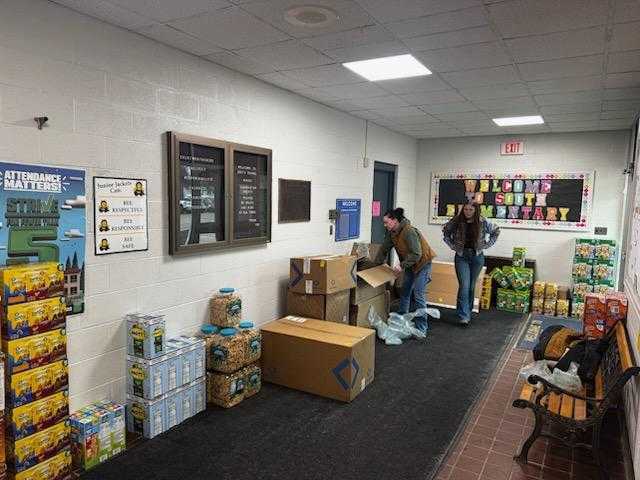
De Saegher Dairy recognized with MMPA Food Bank Legacy Award for helping local students access the food they need to learn, grow and succeed.
When Bart and Els De Saegher moved their family from Belgium to Michigan in 1999, they came with a goal of pursuing their American dream by building a future in dairy farming.
More than two decades later, De Saegher Dairy has grown alongside the family, and the opportunities they found in the United States have shaped how they give back to the community around them.
“We became American citizens, and we are so thankful to be in this country and for the opportunity that the United States gives us,” Lotte Peet, Bart and Els’ daughter said. “We got to live our American dream, and now let’s set up these children so that they can also live out their American dream. They can’t do that if they’re hungry.”
That belief is at the heart of Project FULL (Fuel Up Little Learners), a supplemental nutrition program started by Bart and Els in 2016 to support students in Gratiot County.
Through weekend meal kits, classroom snacks and access to milk for lunch during the school day, Project FULL helps fill gaps that can affect a child’s ability to focus and learn. For the De Saegher family, the program is one way to invest in the same community that has supported their farm and family.
For their commitment to addressing food insecurity, De Saegher Dairy of Middleton, Michigan, was named the 2026 Michigan Milk Producers Association (MMPA) Food Bank Legacy Award recipient.
Living Their American Dream
Before moving to Michigan, Bart and Els dairy farmed in Belgium. In 1999, they purchased a 35-cow dairy near Middleton, Michigan, and began building the operation and future they had envisioned for their family.
Over time, the farm grew, facilities expanded and the next generation became involved. Today, De Saegher Dairy remains a family business, with Bart and Els working alongside their children and their spouses, milking cows across five sites.
“We all wear a lot of hats around here,” Lotte said.
Lotte’s brother, Bram, manages the dairy operations, while Lotte focuses much of her time on public relations and community relationships. Their spouses are involved as well, along with other extended family members, helping manage employees and oversee the operation, which includes two heifer-raising facilities in Kansas. Their youngest brother, Brent, is a sophomore at Michigan State University who recently served as Michigan FFA state president and is now seeking a National FFA officer position.
For Bart, what the family has built comes back to the opportunity they were seeking when they moved to the United States.
“It is to live in a country where you can accomplish your dreams,” Bart said of the American dream. “We couldn’t accomplish our dreams where we came from. That’s why we came here. And this is the only place in the world we could have done this.”
With that opportunity came a desire to give back. As the family became more established in Gratiot County, Bart and Els began looking for a way to support the community that had become their home.

Filling the Gap
Project FULL began in 2016 with a focus on providing weekend meals for students who might otherwise go without enough food when school was not in session.
The program provides participating students with two breakfasts, two lunches and two dinners, along with shelf-stable milk. Foods are selected so children can safely prepare them on their own if needed. The bags are placed discreetly into students’ backpacks while they are in class, allowing students to receive assistance without being singled out among their peers.
Today, Project FULL serves students in Ithaca and St. Louis public schools, while a snack program has also been established at St. Mary’s School in Alma. Depending on enrollment during the school year, the program supports between 150 and 250 children.
Project FULL is supported by the De Saegher family along with dairy industry businesses, crop farmers, vendors and other community supporters. An annual golf outing, live auction and silent auction help raise money for the program, while local volunteers help make the work possible.
During the COVID-19 pandemic, the program shifted from locally packed bags to pre-packed Weekend Kits purchased through the Greater Lansing Food Bank, part of the Food Bank Council of Michigan distribution system. Today, Project FULL operates through the Gratiot County Community Foundation, which provides the nonprofit structure for the program while the De Saegher family continues to lead and support it.
 “We want to make sure that they are all ready to learn and are healthy,” Lotte said. “It is a lot like cows. If you’re not going to raise that calf up with the appropriate nutrients, it is not going to be as successful as it should be.”
As Lotte became more involved in local schools, she began noticing other ways food insecurity could affect students and teachers. One of those needs was classroom snacks. Parents were often asked to contribute snacks or money for their child’s classroom. When families could not participate, teachers were sometimes left to fill the gap themselves.
“So now the teacher has this extra weight to purchase snacks,” Lotte said. “Let’s take that off.”
Several times throughout the school year, Project FULL provides thousands of dollars in classroom snacks, ensuring teachers have food available when students need it.
Project FULL also recently expanded to include something especially meaningful to the De Saegher family: milk.
Making Milk Available
Students receiving free school breakfast or lunch have milk included with their meal. But Lotte learned through the experiences of her own children that students bringing lunch from home were still charged for milk, as were students who wanted a second carton.
For children without money available in their lunch account, that could mean going without. When Lotte realized what was happening, Project FULL established an account to cover those purchases.
“I said, ‘Enough of that,’” she recalled. Now, students who want milk can receive it without worrying about whether there is enough money in their account. It also serves as another way to connect Project FULL with what they know best.
“My parents wanted to do something that would build up the students in this community,” Lotte said. “We also want to make sure that we have a dairy influence. This is a way that we can incorporate that a little bit by making sure that they have healthy, nutritious dairy options.”
Helping provide milk is just one example of how Project FULL has evolved as the De Saeghers have become more aware of the needs around them.
 Building a Legacy
For Lotte, becoming more involved with local schools has changed the way she sees those needs within her own community.
“If you don’t have children in school, you kind of have a blind eye to everything that’s going on,” she said. “I had no idea that people were being charged for milk. I had no idea that teachers were taking the weight of all these snacks on their own. Now that I’m actually immersed in the schools, I see it and I’m grateful to be able to help.”
It has also reinforced her belief that farmers and others in agriculture can make a difference simply by paying attention to what their communities need. Her advice to anyone considering similar work is simple: “Go for it, because there is a need.”
That need continues to shape Project FULL’s future. As additional schools reach out, Lotte hopes the program can continue growing and supporting more students throughout the area.
“I just want to help as many families and futures as I can,” she said.
The impact is sometimes seen in small moments. Lotte recalled hearing about a student who missed receiving his weekend food bag because school had been canceled on Friday for a snow day. When he returned, he asked his principal if he could still have it. For Lotte, the moment was less about the bag itself and more about knowing the program was providing something a child genuinely relied on.
“That just makes you thankful for it, knowing that it’s appreciated,” she said. “Whether it’s appreciated by families or if it’s appreciated by a student, it makes it worth it.”
Receiving the MMPA Food Bank Legacy Award is recognition of years of work, but for the De Saegher family, the purpose remains straightforward: give local children what they need today so they have a better chance at tomorrow.
“Knowing that you play a small part in a child’s future,” Lotte said, is the most rewarding part. “That’s why we’re doing it.”
This article was originally published in the September/October 2026 issue of the Milk Messenger. Subscribe »