

Michigan’s dairy industry has long been built on a foundation of innovation, education and collaboration. Today, that legacy continues through two major initiatives at Michigan State University (MSU): the Dairy Cattle Teaching and Research Center Campaign and the Dr. Joe Domecq Dairy Education Endowment.
The two initiatives are separate efforts, but as those closest to them explain, neither reaches its full potential without the other.
“They go hand in hand,” said Dr. Cathy Ernst, MSU Chairperson, Department of Animal Science. “The facility is necessary for us to teach our students, but this endowment is focused on our teaching mission. We need the facilities, but we also need the teaching expertise and the curriculum to drive what we do.”
That connection starts with the facility itself, an effort shaped not just by university leadership, but by the dairy industry.
“We started to hear from people, ‘How can we help?’” said Dr. George Smith, MSU Director of AgBioResearch. “So, then we started to think about what might be a goal or a strategy that would resonate with our producers.”
The result was a simple, collective ask: $2.50 per cow. Across Michigan’s dairy herd, that approach could generate roughly $1 million in support, while also sending a clear message about the industry’s commitment.
“It’s something tangible,” Smith said. “If successful, it would add up to about a million dollars and be a strong testament and endorsement from our dairy producers of the value they see in this effort.”
That endorsement goes beyond fundraising.
“Having this statement of support from the industry will carry a lot of weight,” he added. “It will really help us as we approach other donors to solidify that foundation for the future.”
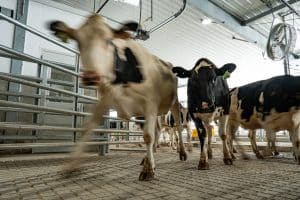
While the facility represents a major step forward in infrastructure, its real impact will come from what happens inside it: research, outreach and, most importantly, student training.
“Through the research at the dairy and training the workforce of the future, we will make a direct contribution to helping dairy farms be profitable,” Smith said.
He emphasized that exposure to modern dairy practices is critical, especially for students who didn’t grow up on farms.
“Having a controlled experience for people that didn’t grow up on a dairy farm and introducing them to all of the technology involved in a modern dairy operation will be instrumental to recruiting the workforce of the future,” said Smith.
That’s where the Domecq Endowment becomes essential.
“This endowment allows us to have the flexibility to fund teaching staff, as well as fund student activities and student support,” Ernst said.
As the MSU dairy program is seeing steady growth in enrollment, those resources are increasingly important.
Dr. Joe Domecq stated, “Enrollment in the MSU Dairy Education program continues to grow with students coming from across the country, and as we adapt our curriculum to reflect the latest dairy practices and technology, there is a need for additional academic staff with practical dairy experience. Maximizing the value of the new dairy facility within the education program will require additional instructors who can effectively teach students with varying levels of experience. The financial support allows us to continue building and strengthening the program for the future.”
Hands-on experience is a major focus moving forward.
“One of our goals is to have the robot portion be a student-run herd,” Ernst explained. “So that students would come away with having actually managed their own robotic herd so that they’re ready to go out to the industry where those technologies are common.”
For producers, that preparation translates directly into a stronger workforce.
“This ensures that the employees they’re hiring have had the latest training and opportunities to be ready to fill the jobs that are out there and that will be jobs of the future,” Ernst said.
That workforce impact is something dairy producer and MMPA board member, Eric Frahm, has experienced firsthand, “The new dairy facility will deliver long-term value to the dairy industry across Michigan and the Great Lakes region. It will allow MSU to train students to support the industry in a variety of ways. On our farm, we’ve worked with MSU alumni in nutrition, veterinary care, reproduction and consulting. While modern facilities create opportunity, it’s the people who ultimately determine how far that opportunity goes, making the Domecq Endowment just as critical as the facility itself.”

Support is already being demonstrated by producers who have witnessed the program’s value. Dairy producer and MMPA member, Ken Gasper, said the experience speaks for itself, “We’ve had three generations from our dairy complete MSU’s two-year dairy management program, and I truly believe it’s one of the best in the country. When you look across Michigan and see how many farm owners, herdsmen and employees are MSU graduates, it shows the impact the program has had on our industry. Having a fully funded endowment will ensure we have funds to hire the best individual in the future to continue the legacy that has been established. That’s why we’re proud to support the Domecq Endowment.”
And while the two efforts are funded separately, both Smith and Ernst emphasized that their impact is shared.
“For us to be most effective in training students, we need state-of-the-art facilities,” Ernst said. “But the facility without the mission happening won’t have a real impact. It’s the things we can do in that facility.”
“They’re very, very closely interconnected,” Smith added. “What a great way to honor Dr. Domecq and his legacy and support those programs at the same time.”
Together, the Dairy Facility Campaign and the Domecq Endowment represent a full-circle investment, one that supports both the space where learning happens and the people who make it meaningful.
As Ernst states, “If we can have the resources that we need to make sure students are as prepared as possible, I think it’s a win-win for everyone, for the students and the producers in the state and beyond.”
And for Michigan’s dairy industry, that shared investment is what will carry it forward.
HOW TO SUPPORT
MSU Dairy Facility Campaign
The new Dairy Cattle Teaching and Research Center (DCTRC) reflects MSU’s ongoing commitment to Michigan’s dairy industry and rural communities. Advocacy from the dairy community led the state of Michigan to invest in this facility, but to fully fund it, additional private support is needed.
Goal
Raise $2.50 per cow in Michigan to help collectively raise $1 million.
Giving Levels
Gifts can be pledged over three to five years, making it easier for farms of all sizes to participate.
Under $10,000: recognition in the Visitor Center
$10,000, $25,000, $50,000: tiered recognition on the Michigan Dairy Hall of Fame
$50,000 and up: space-naming opportunities
How to Give
Online at https://give.msu.edu/?sid=20997
Mail a check to University Advancement 535 Chestnut Road, Room 300 East Lansing, MI 48824 with “DCTRC Producers Campaign” specified in the memo line.
Call or email Kyle Cutler at 616-204-6648 or cutlerky@nullmsu.edu.
Dr. Joe Domecq Dairy Education Endowment
Thanks to support of dairy producers and industry partners an endowment was established in 2023 to recognize Dr. Joe Domecq’s lifelong service to the dairy industry. Efforts are now underway to build on the initial endowment to not only honor Dr. Domecq, but to expand teaching capacity of MSU dairy education programs, launch a student run herd and develop a stand-alone Dairy Science major at MSU.
Goal
Raise $2.5 million to expand the Dr. Joe Domecq Dairy Education Endowment.
Giving Levels
Any amount will help reach the goal. Donors who contribute $10,000 and more will be recognized on a plaque at various levels of giving.
Platinum >$250,000
Gold $150,000-249,99
Silver $50,000 – 149,999
Bronze $10,000 – 49,999
How to Give
Online at https://givingto.msu.edu/ gift/?sid=9436
Mail a check to Michigan State University, Department of Animal Science, 474 S Shaw Ln #1290, East Lansing, MI 48824, made payable to Michigan State University and designate: Domecq, CANR (A105121)
This article was originally published in the May/June 2026 issue of the Milk Messenger. Subscribe »