
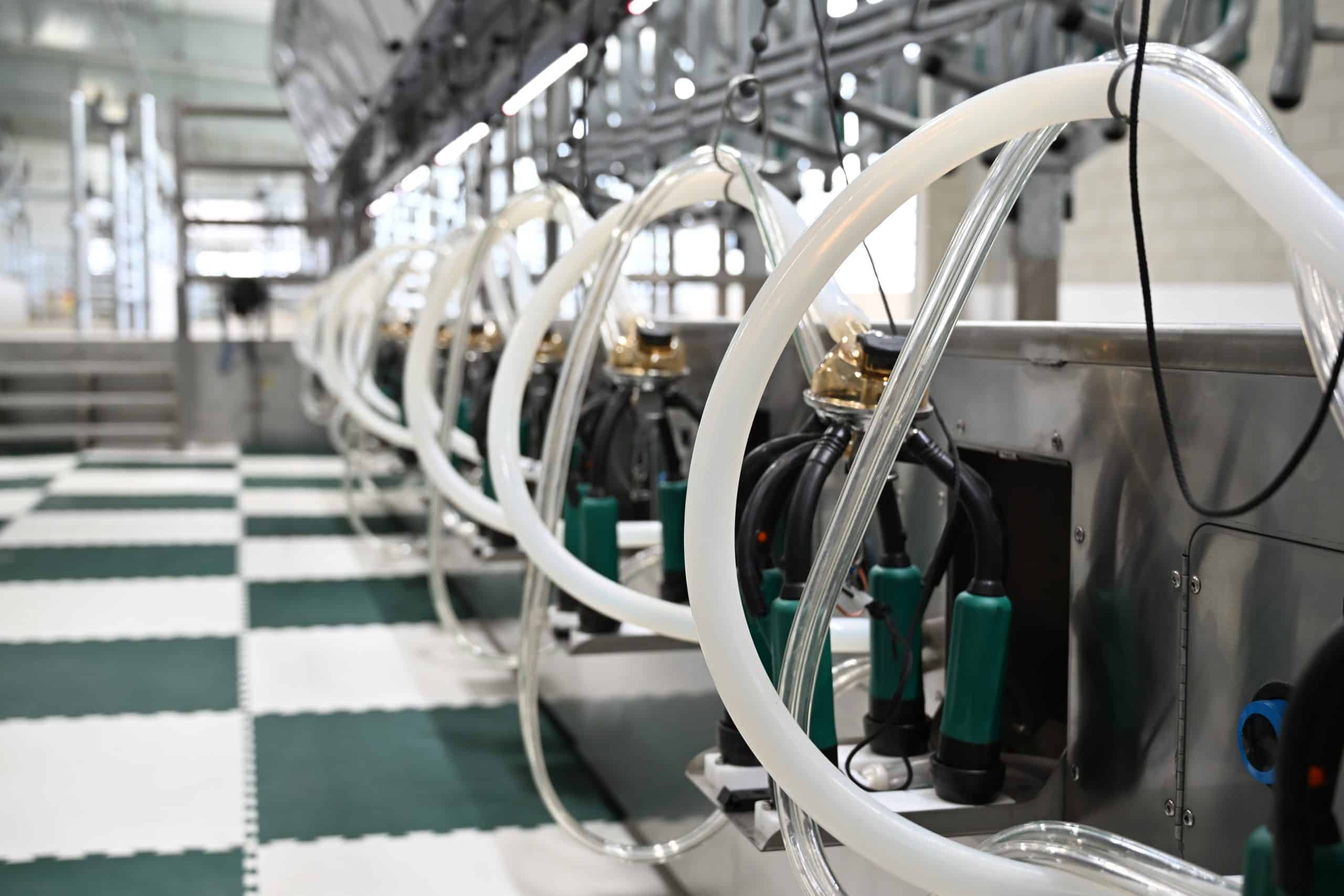
Inside the Michigan State University Dairy Teaching and Research Center
The brand-new Michigan State University (MSU) Dairy Teaching and Research Center is buzzing with anticipation and energy. The facility, years in the making, represents a once-in-a-generation investment in Michigan’s dairy industry. For decades, the old MSU dairy served students, faculty and producers well, but it had been stretched far beyond its limits. Now, the new center is poised to open its doors, providing unparalleled opportunities for education, research and innovation that will shape the future of dairy in Michigan and across the country.
Building for the Future
For years, the idea of replacing MSU’s aging dairy facility floated around campus and industry conversations, but it never quite gained traction. That changed when the right people, the right funding and the right moment came together.
“When I started at MSU in 1997, the dairy was already old,” Dr. George Smith, Director of Michigan State University AgBioResearch, said with a smile. “People who worked there in the ’70s thought it was outdated back then, and their kids and grandkids came back decades later and said the same thing. But this time, the stars aligned.”
That alignment came from multiple directions; Michigan legislators who understood the economic power of dairy, industry leaders who championed the vision, and university administrators who prioritized making it happen. The result is a state-of-the-art teaching and research center designed to strengthen Michigan’s role as a leader in dairy production and innovation.
“Dairy is Michigan’s number one agricultural sector,” Dr. Smith explained. “This facility is about positioning MSU, and the state, to meet the challenges ahead. From workforce development to sustainability to cutting-edge research, it’s an investment in the future of our industry.”
And that vision shows up in every corner of the new center. Designed to house 688 cows and equipped with advanced automation, robotic milking systems and integrated environmental technologies, the facility is built to handle today’s needs while staying nimble enough to adapt for decades to come. Dr. Barry Bradford, the Clinton E. Meadows Endowed Chair in Dairy Management and Nutrition at MSU, explained that flexibility was one of their top priorities during the planning process.
Dr. Bradford described, “Our mantra throughout the project was, ‘Can we build it to do both?’” “We knew the old dairy lasted more than 60 years. This one needs to be able to support research questions we can’t even predict yet.”
From wide, two-way alleys to divided holding pens, every detail is meant to make research easier while also mimicking real-world commercial dairy conditions. The design allows researchers to study cow behavior, feeding strategies and new technologies in ways that reflect exactly what producers face on their own farms.

A Living Laboratory
The new dairy isn’t just bigger, it’s built to answer the questions that matter most to farmers. In the past, MSU researchers often had to wait years to start projects because there simply wasn’t enough space or access to cows. Now, with room for replicated free-stall pens, robotic systems and advanced sensors throughout the facility, those delays are gone.
“We can finally ask applied questions at a scale that really matters to producers,” Dr. Bradford said. “Take something like cow brushes, producers love them, cows love them, but we’ve never had data showing if they actually pay for themselves. Now we can run controlled trials with five pens using them and five without to measure the impact.”
That ability to replicate pens and isolate variables opens the door for research on everything from feed efficiency to cow comfort to environmental sustainability. And the integration with MSU’s anaerobic digester makes the facility especially unique.
“We want to create circularity in the dairy economy,” Dr. Smith stated. “Farmers shouldn’t just get paid for milk. By exploring renewable energy and nutrient recovery, we’re developing models that could give producers entirely new revenue streams.”
This connection to sustainability runs throughout the dairy’s design. From automated sand separation to water-efficient smart soakers that spray cows only when they’re present at the feed bunk, every system is optimized to conserve resources while improving animal welfare. Researchers will also collect detailed data on energy, water, methane emissions and other key metrics, giving producers access to real-world numbers that can help inform better on-farm decisions.
And while the technology is impressive, Dr. Bradford emphasized that the goal wasn’t just to build a flashy barn. “We designed this place to look and feel like a commercial dairy,” he explained. “That makes our data more believable, but it also prepares students for real-world work after they leave MSU.”

Inspiring the Next Generation
Perhaps one of the most exciting impacts of the new facility is on education. Built with two classrooms on-site and designed to host hands-on labs, workshops and tours, the dairy is expected to draw students from across the country, and it already has.
“In the past year, we’ve seen students from across the country come visit the dairy program,” Dr. Bradford shared. “The facility gets people’s attention, and once they see the opportunities here, they want to be part of it.”
That attention isn’t just coming from future dairy producers. The center is designed to bring together students and faculty from multiple disciplines, veterinary medicine, agricultural engineering, economics, environmental science and more, to work side by side on complex dairy challenges.
“The dairy industry is interconnected,” Dr. Smith explained. “From feed and animal care to renewable energy and data science, we need experts from all areas working together. This facility finally gives us the space and tools to make that collaboration possible.”
Outreach is also a priority. The facility includes a visitor center with interactive displays and a glass viewing area where guests can watch cows being milked. Plans are underway to host open houses, school tours and hands-on events, helping connect the public with modern dairy practices.
But at the heart of all of this is MSU’s commitment to Michigan producers. Dr. Bradford summed it up simply, “If I could invite every Michigan dairy farmer to walk through, I’d want them to know this: MSU is here to help you find solutions to your real problems. That’s why this facility exists.”

Looking Ahead
The first cows moved in this summer, and the excitement around the facility is only growing. While operations are still ramping up, the team is already planning a grand opening and ribbon-cutting ceremony for spring 2026, when producers, legislators and the public will officially celebrate this milestone for Michigan’s dairy community.
“This facility is a testimony to MSU’s commitment to Michigan’s dairy industry,” Dr. Smith said. “It’s a sizable investment, but we’re confident it will pay off for producers, students and the future of dairy in our state.”
Dr. Smith also expressed deep gratitude to the Michigan Milk Producers Association and its members for helping make the vision a reality.
“This project wouldn’t have happened without MMPA’s leadership and support,” he said. “From advocating with elected officials to championing the importance of this investment for Michigan agriculture, MMPA played a critical role in bringing this facility to life.”
With the partnership between MSU and Michigan’s dairy producers stronger than ever, the new MSU Dairy Teaching and Research Center is set to drive innovation, education and opportunity for decades to come.
5 Things You Should Know About the New MSU Dairy
- It’s One of the Largest University Dairies in the Country
The new facility houses 688 cows, putting MSU in the same league as Cornell and the University of Florida, with the added advantage of being just minutes from campus for easy student access. - Cutting-Edge Research Will Happen Here
From cow behavior and feed efficiency to environmental sustainability and renewable energy, researchers can now study real-world, producer-focused challenges at a scale that mirrors commercial dairies. - Smarter Systems and Automation
With robotic milkers, smart soakers that spray cows only when they’re at the bunk and advanced automation for lighting, ventilation and manure management, the dairy is one of the most automated research barns in the U.S. - A Hub for Hands-On Learning
Two classrooms on-site and a design built for labs and workshops mean more opportunities for students, from future producers to veterinarians, engineers and sustainability experts, to learn on real dairy systems. - Innovation Meets Sustainability
The facility connects directly to MSU’s anaerobic digester, turning manure into renewable energy while exploring cost-effective nutrient recovery technologies that could open new revenue streams for farmers.
This article was originally published in the September/October 2025 issue of the Milk Messenger. Subscribe »